Is France's Most Radical Wine Region the Jura?
Tucked between Burgundy and the Swiss Alps, a narrow strip of vineyard land produces some of the most unusual and compelling wines in the world.
There are wine regions that announce themselves with grandeur, sprawling across landscapes so famous they barely need introduction. The Jura is not one of them. This slender corridor of vineyards along the western foothills of the French Alps produces a fraction of the volume of its celebrated neighbor Burgundy, yet what it lacks in scale it compensates for with an originality no other region in France can convincingly replicate.
The wines here are unlike anything else. Some are deliberately oxidized, aged for years under a veil of yeast that transforms them into something closer to dry sherry than conventional white wine. Others are sweet, golden, and impossibly concentrated, made from grapes left to shrivel on straw mats for months after harvest. Still others are fresh, mineral, and thoroughly modern. The Jura resists neat categorization, which is precisely what makes it one of the most rewarding regions to explore for anyone seeking wines that challenge expectation and expand the definition of what a glass of French wine can be.
Jura is one of France’s smallest and most unique wine regions, located in eastern France near the Swiss border between Burgundy and Switzerland.
A Narrow Kingdom Between Burgundy and the Alps
The Jura lies in the Franche-Comte region of eastern France, a thin band of vineyard territory stretching roughly 80 kilometers from north to south but rarely more than a few kilometers wide. To the west sits Burgundy, whose influence on the Jura is both historical and viticultural. To the east, the terrain rises sharply toward the Jura Mountains and, beyond them, Switzerland. The vineyards are planted predominantly on west-facing and southwest-facing slopes at elevations ranging from 250 to 400 meters, capturing afternoon sunlight while exposing the vines to the cool continental climate that defines the region's character.
Winters are cold and long. Springs arrive late and carry the persistent threat of frost. Summers are warm but moderated by altitude, and autumns are often dry enough to allow for extended hang time on the vine, a critical factor for the region's late-harvest wines. The soils are predominantly limestone and marl, with pockets of clay that shift from one hillside to the next, creating a patchwork of microclimates and terroir expressions that give individual vineyards distinct personalities. The four principal appellations are Arbois, the largest and most recognized; Château-Chalon, devoted almost exclusively to a single wine style; L'Étoile, named for the tiny star-shaped fossils embedded in its soils; and the broader Côtes du Jura, which encompasses vineyards scattered across the entire region.
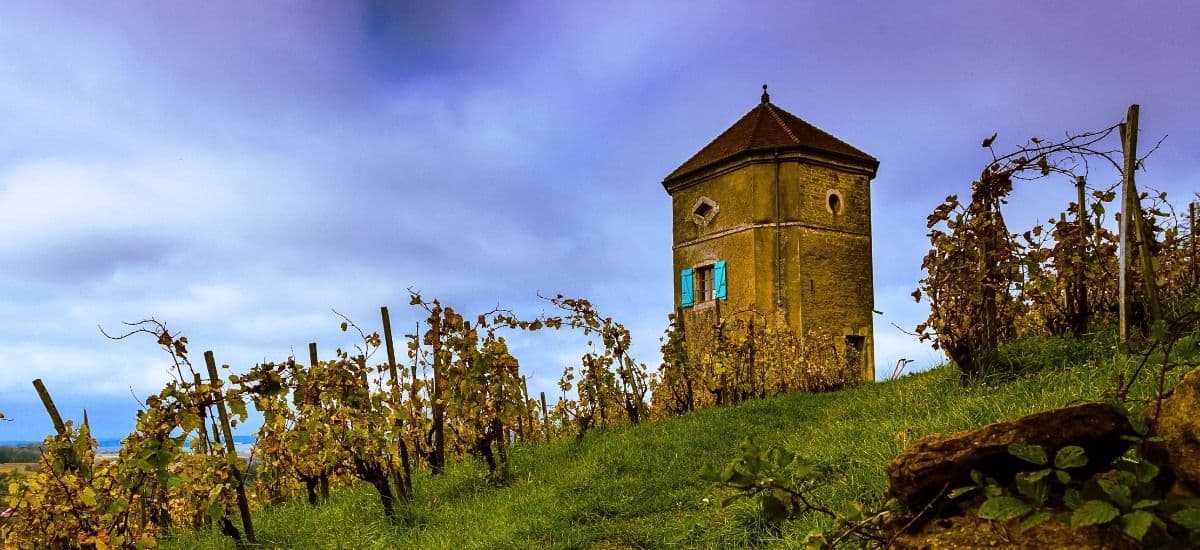 Jura’s soils include limestone, marl, and clay, contributing to mineral-driven wines with structure and precision.
Five Grapes and the Wines They Become
The Jura works with five permitted grape varieties, three of which are considered indigenous and two of which are shared with Burgundy. Chardonnay is widely planted here and performs beautifully in Jurassien limestone, producing whites that range from crisp and unoaked to richly textured and deliberately oxidative depending on how the winemaker chooses to handle them. Pinot Noir also appears, yielding lighter, earthier reds than its Burgundian counterparts, though it plays a supporting role compared to the native varieties.
The real soul of the Jura lives in its indigenous grapes. Savagnin, a thick-skinned white variety related to Gewurztraminer, is responsible for the region's most iconic wines. When aged in partially filled barrels where a film of yeast called voile develops on the surface, Savagnin produces Vin Jaune, a profoundly nutty, oxidative wine aged for a minimum of six years and three months. When vinified without the voile, it creates an entirely different wine: fresh, aromatic, and mineral-driven. Poulsard, sometimes spelled Ploussard, is the Jura's most planted red grape. It produces remarkably pale, translucent reds with delicate aromatics of red berries and spice that can surprise anyone expecting a deeply colored wine. Trousseau, the other native red, offers more structure and darker fruit but remains relatively light by broader French standards. Together, these five grapes produce a range of wine styles that few regions of comparable size can match.
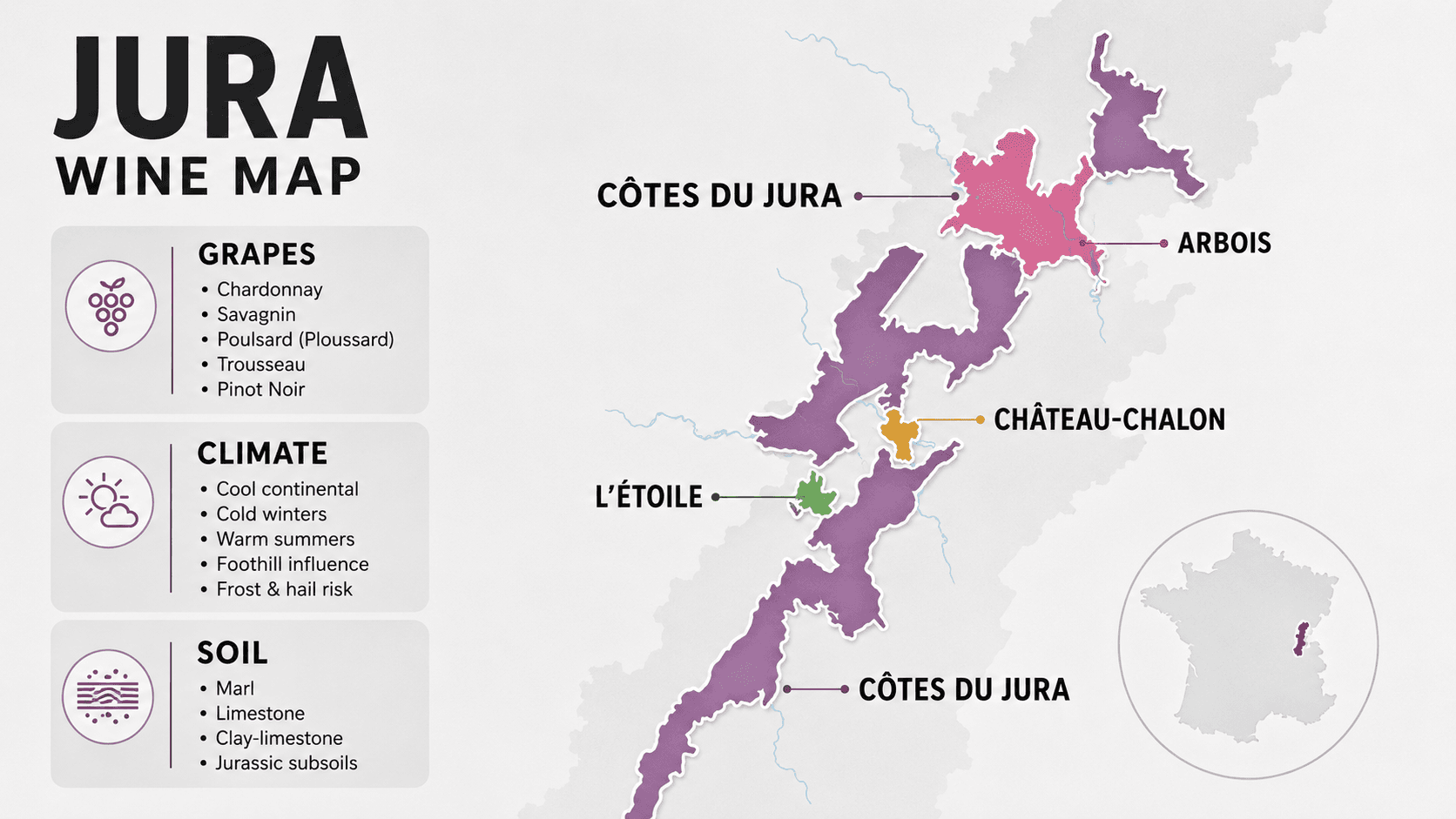 The region is influenced by its continental climate and its proximity to the French Alps and the Jura Mountains (Revermont Escarpment).
From Vin Jaune to Vin de Paille: A Region of Singular Styles
What distinguishes the Jura most dramatically is not simply its grapes but the distinctive winemaking traditions that have survived here for centuries. Vin Jaune is the flagship, a wine without true parallel anywhere else in the world. Produced exclusively from Savagnin, it undergoes oxidative aging in old oak barrels intentionally left unfilled, allowing oxygen to interact with the wine while the protective voile prevents it from becoming vinegar. The result is a wine of startling intensity: dry, golden, layered with walnut, curry spice, and a saline minerality that lingers on the palate for minutes. It is bottled in a distinctive 62-centiliter bottle called the clavelin, sized to represent what remains of a full liter after six years of evaporation.
Vin de Paille, or straw wine, takes a different approach to concentration. Grapes are harvested and laid on straw mats or hung in well-ventilated rooms for several months, allowing them to dehydrate and intensify their sugars before pressing and fermentation. The resulting wine is rich, honeyed, and deeply aromatic. Beyond these specialties, the Jura also produces Cremant du Jura, a traditional-method sparkling wine that has gained significant recognition in recent years for its quality and value. Macvin du Jura rounds out the portfolio, a fortified wine made by blending unfermented grape juice with marc brandy. Each of these styles reflects a regional philosophy that values patience and individuality over convention.
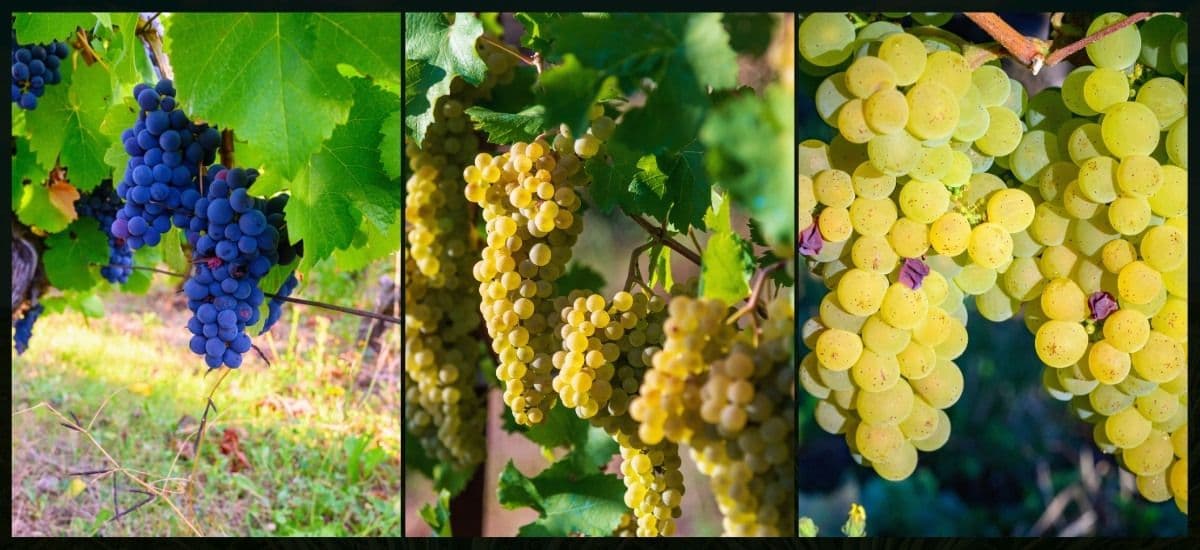 While Chardonnay (center) and Poulsard (left) are grown here, Savagnin (right) is Jura’s most iconic grape.
The Takeaway
The Jura occupies a unique position in the French wine landscape, a place where ancient techniques and indigenous varieties create wines that exist nowhere else. It is simultaneously one of the country's smallest production zones and one of its most diverse, offering everything from sparkling wines and delicate reds to some of the most age-worthy whites produced anywhere. For those approaching wine with fresh curiosity, the Jura provides an immediate lesson in how profoundly place and tradition shape what ends up in a glass.
For those already familiar with the broader world of French wine, it serves as a reminder that the most exciting discoveries often lie just outside the famous boundaries. The region rewards patience, both in the aging of its wines and in the attention required to understand them. A single bottle of Vin Jaune or a glass of Poulsard from a thoughtful producer can fundamentally reframe assumptions about what French wine is supposed to look like, smell like, and taste like. The Jura does not compete with Burgundy or Bordeaux. It offers something they cannot, and that is reason enough to seek it out.


