
Cava is Spain's Generous Sparkler
Made by the same painstaking method as Champagne yet priced for everyday joy, Cava may be the most versatile bottle in the room. Its finest examples are quietly rewriting what Spanish sparkling wine can be.
Two neighboring nations share one rugged peninsula, a deep well of native grapes, and a tradition of place-driven winemaking that the rest of the world is only beginning to fully appreciate.

The Iberian Peninsula is a single body of land, a granite and limestone wedge pushed out into the Atlantic and lapped along its southern and eastern edges by the Mediterranean. Spain and Portugal divide it between them, and for centuries each cultivated its vineyards in near isolation, walled off from the rest of Europe by the Pyrenees and from one another by language, history, and a long contested border. That isolation proved to be a gift. While France and Italy refined a handful of internationally famous grapes, Iberia quietly preserved hundreds of native varieties that grow almost nowhere else, each adapted to a particular slope, soil, and slant of light.
This guide travels across that landscape with attention to three things: where the wines come from, which grapes give them character, and what styles emerge when the two meet. We begin in Spain, moving from the classic reds of the north through the Atlantic whites of the west, the sparkling and slate-grown wines of the Mediterranean coast, and the singular fortified wines of the deep south. Then we cross into Portugal, a smaller country with an outsized share of the peninsula's vinous treasure. The organizing idea throughout is place, because in Iberia, place explains nearly everything.
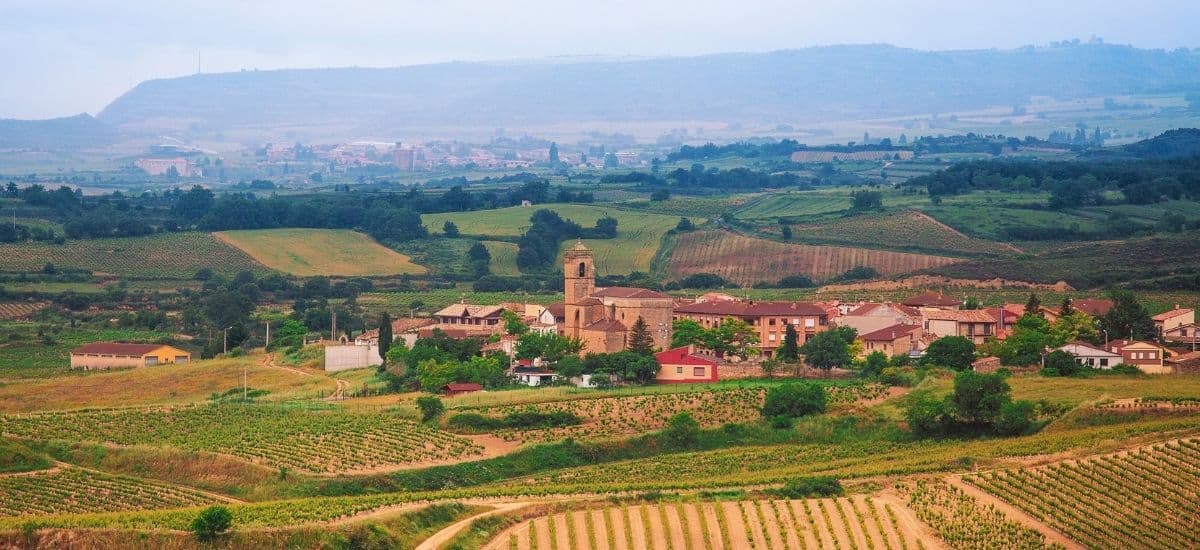
Rioja is Spain's most famous wine region, known primarily for Tempranillo-based red wines that often spend significant time aging in oak.
No Spanish region carries more recognition than Rioja, and for good reason. Tucked into the north along the Ebro River, it spreads across three subzones, the cooler Rioja Alta and Rioja Alavesa and the warmer, lower Rioja Oriental. Its signature grape is Tempranillo, often blended with Garnacha, Graciano, and Mazuelo. For more than a century Rioja built its identity not on individual vineyards but on aging, a system codified in the familiar tiers of Crianza, Reserva, and Gran Reserva. A Gran Reserva matures at least five years before release, including two in oak, and the long rest in American barrels and bottle yields the mellow, savory style the region made famous.
That heritage is now in lively conversation with a newer way of thinking. In 2017 the regulatory council introduced geographic classifications that look toward Burgundy rather than the cellar clock. Vino de Zona identifies a subzone, Vino de Pueblo names one of the region's villages, and Viñedo Singular recognizes exceptional single vineyards planted with vines at least thirty-five years old and harvested by hand. The shift reflects a broader debate between the traditional camp, which prizes blending and patient barrel age, and a younger movement determined to show that a specific slope of Rioja soil can speak as clearly as any grand cru. Both visions now share the shelf, and the region is richer for the argument.
Follow the Duero River west from Rioja and the land climbs onto a high, austere plateau where vines endure brutal extremes. Ribera del Duero sits above 2,500 feet, baked by day and chilled hard by night, and that swing concentrates color and tannin in the local strain of Tempranillo known as Tinto Fino or Tinta del País. The wines are darker, denser, and more brooding than their Rioja cousins, built for the long haul. This is the home of Vega Sicilia, the estate whose Único bottling helped establish Spain as a source of world-class red long before the rest of the country caught up. A short distance west, the Toro region pushes the same grape, called Tinta de Toro here, into even hotter conditions, yielding reds of almost ferocious power.
The plateau is not red wine alone. Just southwest of Ribera lies Rueda, the country's most important source of crisp white, built on the Verdejo grape. Picked from the same kind of stony, sun-struck soils that give the reds their muscle, Verdejo turns out something entirely different, a bright, herbaceous, citrus-and-fennel white with a faintly bitter almond finish that makes it one of Spain's most reliable everyday pleasures. Together these appellations form a corridor of contrasts, where altitude and a single river thread bind brawny reds and zesty whites into one continuous story of the Castilian interior.
Turn to the country's rain-soaked northwest corner and Spain becomes almost unrecognizable. Galicia is green, cool, and Atlantic, a land of granite, estuaries, and near-constant ocean influence that has more in common with coastal Portugal than with the sunbaked interior. Its calling card is Rías Baixas, named for the dramatic flooded river valleys, the rías, that cut inland from the sea. The grape is Albariño, and in this maritime setting it produces a white of singular tension, all lime, white peach, and a salty, almost briny snap that seems to carry the ocean itself. These are wines of nerve and freshness, and they have done as much as any others to teach the world that Spain makes great whites.
The surprises continue inland. The Ribeiro and Valdeorras regions have revived Godello, a noble white grape capable of richer texture and stony depth, while Ribeira Sacra clings to impossibly steep terraces above the Sil and Miño rivers, where growers practice a kind of heroic viticulture to coax elegant, peppery reds from the Mencía grape. The wines of green Spain reward the curious precisely because they upend every assumption a newcomer might bring to a country still too often imagined as uniformly hot and red. To taste them is to understand that the Iberian story is coastal as much as continental.
On the Mediterranean side of the country, Catalonia offers two faces of Spanish wine that could hardly differ more. The first is Cava, the traditional-method sparkling wine born in the Penedès region southwest of Barcelona, made by the same labor-intensive bottle fermentation as Champagne but from native grapes, chiefly Macabeo, Xarel·lo, and Parellada. Long dismissed as cheap fizz, Cava has spent recent years rebuilding its reputation. New rules divide it into Cava de Guarda and the longer-aged Cava de Guarda Superior, which gathers the Reserva, Gran Reserva, and Paraje Calificado tiers, while the production area is now mapped into zones such as the Comtats de Barcelona to give drinkers a clearer sense of origin.
The second face is Priorat, a small, mountainous interior zone that produces some of Spain's most coveted and concentrated reds. Its secret lies underfoot, in a distinctive black slate soil called llicorella that forces vine roots deep in search of water and yields tiny, intense crops. Old-vine Garnacha and Cariñena grown on these slopes give powerful, mineral-laced wines of remarkable density. Priorat is one of only two regions in Spain to hold the top DOQ classification, a status it shares with Rioja, fitting recognition for a place that turns stone and struggle into something profound. Between the festive and the formidable, Catalonia contains both extremes of the Spanish character.
In the far south, in the sun-bleached corner of Andalucía around Jerez de la Frontera, Spain produces a wine unlike any other on earth. Sherry begins as a still white from the Palomino grape, grown on dazzling white albariza chalk soils, then fortified and matured through one of the most ingenious systems in all of winemaking. Some barrels develop a living veil of yeast on the surface called flor, which shields the wine from oxygen and gives the bone-dry styles known as fino and manzanilla their pungent, saline character. Others are fortified higher, killing the flor and leaving the wine to age in contact with air, producing the deep, nutty richness of oloroso. The wines are blended through a solera, a tiered stack of barrels in which older and younger wines are perpetually married.
The result is a spectrum of staggering range. At the dry end sit fino and manzanilla, then amontillado and the elusive palo cortado, each step adding color and depth. At the far end lies Pedro Ximénez, a sweet, viscous, raisined wine almost black in the glass. For decades Sherry was misunderstood as a sticky relic, but a global revival has restored its standing among the most complex and food-friendly wines made anywhere. Few wines on earth ask so little and give so much, and none demonstrate more vividly how human ingenuity can turn a modest base wine into something genuinely profound.
If Spain reveals its variety across great distances, Portugal compresses an almost equal diversity into a far smaller frame. The two countries share the same peninsula, a common reliance on indigenous grapes, and a long life on the Atlantic, yet Portugal developed its own vocabulary entirely. Crossing the border westward, the language of wine changes, the grape names grow unfamiliar, and a country too often overlooked reveals itself as one of the most original wine cultures in all of Europe.
Portugal's greatest asset is its sheer wealth of native grapes, a catalog of hundreds of varieties found almost nowhere else, most still going by names a casual drinker will never have heard. Nowhere is this inheritance richer than in the Douro Valley, the steeply terraced gorge of schist where the river of the same name carves through the north. The Douro is famous for Port, but in recent decades it has emerged as a source of superb dry red table wine built from the same grapes, above all Touriga Nacional, Touriga Franca, and Tinta Roriz, the Portuguese name for Tempranillo. These reds are dark, floral, and structured, proof that the valley's punishing slopes can speak in more than one voice.
Farther northwest, hard against the Atlantic and the Spanish border, lies the cool, rainy region of Vinho Verde. The name means green wine, a reference not to color but to youth, for these are wines meant to be drunk fresh, often with a faint natural spritz. The lightest examples are simple and thirst-quenching, but the serious ones, built on Alvarinho, the same grape Spain calls Albariño, and on the floral Loureiro, rank among the most refined whites in the country. Together the Douro and Vinho Verde mark the two poles of the Portuguese north, one all power and structure, the other all freshness and lift.
Portugal's gift to the world of fortified wine begins with Port, made in the Douro Valley from those same native grapes. The crucial difference is timing: fermentation is halted partway through by adding clear grape spirit, which kills the yeast, preserves natural sweetness, and lifts the alcohol. From there the wine divides into two great families. The ruby styles, culminating in Late Bottled Vintage and the prized Vintage Port, age mainly in bottle and keep their deep, brooding fruit. The tawny styles age for years in cask, slowly oxidizing toward amber and flavors of fig, caramel, and walnut, and are sold either with an indication of age such as ten or twenty years or, as a Colheita, from a single declared harvest. Vintage Port, declared only in exceptional years, can improve for decades.
Then there is Madeira, perhaps the most extraordinary wine on the planet. Made on a volcanic Atlantic island, it is deliberately heated and exposed to air through processes called estufagem and canteiro, the very treatments that would ruin most wine. Why does it last forever? Because it has already endured the worst. Having been cooked and oxidized on purpose, a Madeira is essentially indestructible, and bottles from the nineteenth century still drink beautifully today. Its styles run from the bone-dry Sercial through Verdelho and Bual to the lusciously sweet Malmsey, a single island producing a full arc of sweetness from one remarkable method.
Beyond the celebrated north and the great fortified houses lies a Portugal still waiting to be discovered. In the granite highlands of Dão, Touriga Nacional and its companions produce reds of unusual elegance and perfume, while the local Encruzado yields one of Portugal's finest dry whites. Just to the west, the cool, clay-rich region of Bairrada champions the Baga grape, a thick-skinned, high-acid variety that can make stern, age-worthy reds and, increasingly, excellent traditional-method sparkling wine. These are the wines that reward patience and curiosity, often overlooked in favor of their famous neighbors yet capable of real distinction.
To the south, across the wide, sun-warmed plains of the Alentejo, Portugal shows its most generous and approachable face. Here the reds, built from grapes such as Aragonez, the local name for Tempranillo, along with Trincadeira and the deeply colored Alicante Bouschet, are ripe, supple, and immediately likable. The Alentejo accounts for a large share of the country's production, and its quality has climbed steadily, making it the gateway through which many drinkers first fall for Portuguese wine. From the steep schist of the Douro to these open plains, the country offers a tour through an almost overwhelming roster of grapes that exist nowhere else.
What unites the wines of Spain and Portugal is not a single grape or style but a shared inheritance of place. The Iberian Peninsula spent centuries on the edge of the wine world, and that very remoteness preserved a diversity that more fashionable regions long ago traded away. Spain answers with breadth, stretching from the racy Atlantic whites of Galicia to the brooding reds of the high Castilian plateau and the alchemical fortified wines of the south. Portugal answers with depth, packing an astonishing number of native varieties and two immortal fortified wines into a country smaller than many would guess. In both, geography is destiny, and the grape is only the instrument through which a particular slope, soil, and climate speak.
For anyone willing to look past the familiar names of France and Italy, the reward is enormous. These are among the last great wine regions where genuine discovery is still possible, and where serious quality often costs a fraction of its equivalent elsewhere. The modern era has only sharpened the picture, with Rioja and Cava redrawing their maps around terroir, the Douro proving itself in dry red, and Sherry enjoying a long-overdue revival. To study the wines of the peninsula is to learn that the most rewarding glass is rarely the most famous one. It is the one that carries, faithfully and unmistakably, the taste of a specific place.