Cava is Spain's Generous Sparkler
Made by the same painstaking method as Champagne yet priced for everyday joy, Cava may be the most versatile bottle in the room. Its finest examples are quietly rewriting what Spanish sparkling wine can be.
Few wines work as hard as Cava. It can anchor a sparkling cocktail at the start of an evening, carry a lazy brunch through to early afternoon, and hold its own beside a serious dinner without flinching. This range is not an accident of marketing. It is the product of how the wine is made, through the traditional method, with a second fermentation that takes place inside each individual bottle, the same labor-intensive process that gives Champagne its fine, persistent bubbles and savory depth.
Cava emerged during the late 19th century when Spanish producers sought to create high-quality sparkling wines using the traditional method pioneered in Champagne. Rather than copying French grape varieties outright, many producers relied on native Spanish grapes such as Macabeo, Xarel·lo, and Parellada.
Yet Cava has spent decades as the sensible choice rather than the celebrated one, prized for value and quietly overlooked for prestige. That perception is finally shifting. To understand why, it helps to follow the wine from its Catalan birthplace through the rigorous rules that now govern it, and into a present moment where its most ambitious producers are making sparkling wines that reward patience and a closer look.
 The name "Cava" references the underground cellars traditionally used for aging sparkling wines. Top examples can age for many years and compete with prestigious sparkling wines from around the world.
What Is Cava, and Where Did It Begin?
Cava was born in Catalonia, in the rolling vineyards of the Penedès southwest of Barcelona. The first bottles are credited to Josep Raventós of the house of Codorníu, who in 1872 returned from a trip to Champagne determined to make a sparkling wine at home. The village of Sant Sadurní d'Anoia became the heart of the new industry and is still called the capital of Cava. For years the wines were loosely called Spanish champagne, but as Spain integrated into the European Union the name Champagne was reserved for France alone, and the Catalan word for cellar, Cava, became the wine's own.
The grapes tell their own story of place. The traditional trio of Macabeo, Xarel·lo, and Parellada gives Cava its Mediterranean signature, a bright weave of green apple, citrus, white flowers, and a distinctive saline and almond note. Chardonnay and Pinot Noir are permitted too, and rosé Cava leans on red varieties such as Garnacha and Trepat. Whatever the blend, the method defines the category. A still base wine is made first, then bottled with a little yeast and sugar so a slow second fermentation can occur inside the glass, and the longer the wine rests on its spent yeast afterward, the more toasty, bread-like richness it gains.
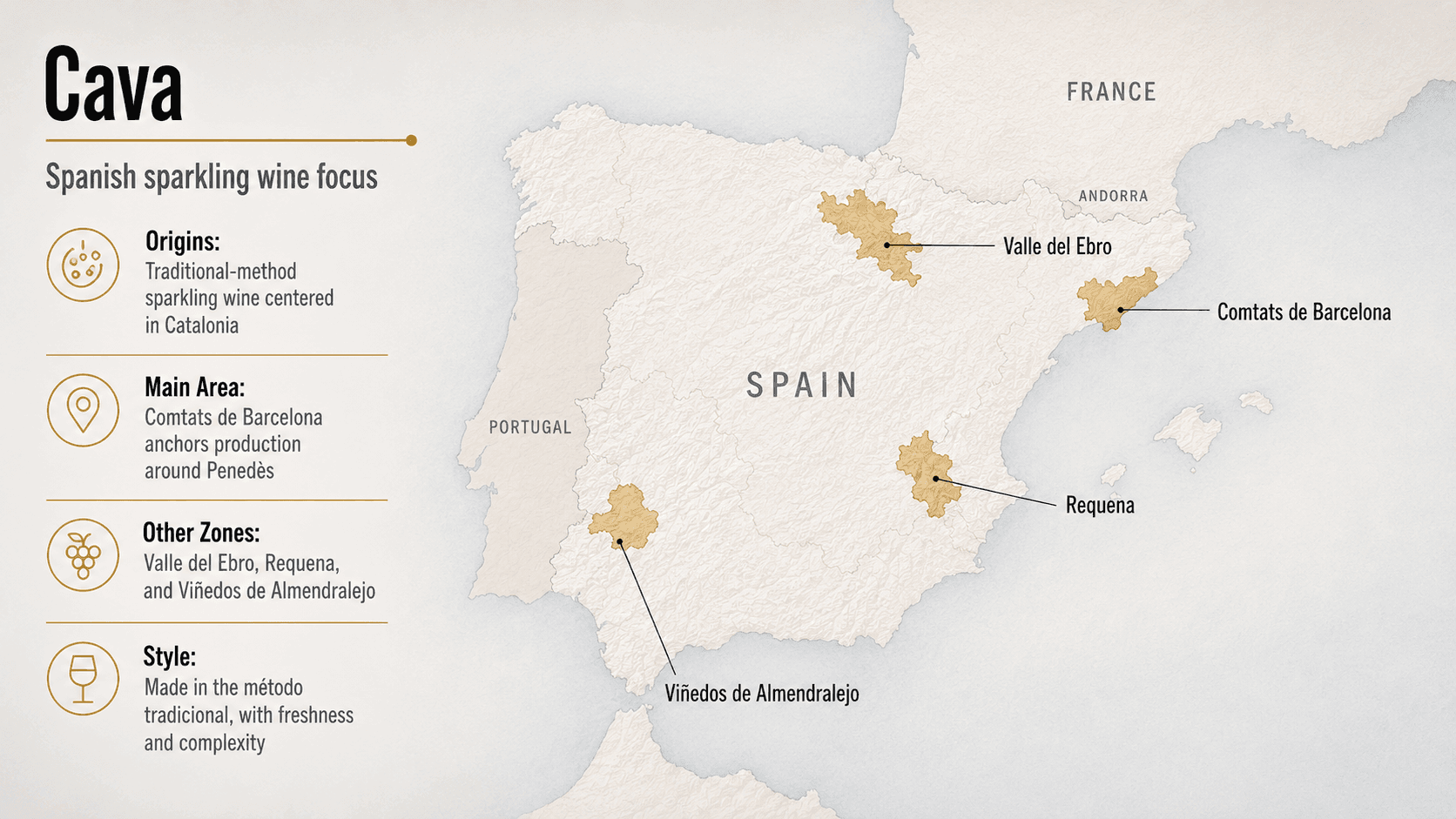
 Although most production is centered in Catalonia, particularly around Penedès, the category has expanded to several approved regions throughout Spain.
A Denomination Unlike Any Other in Spain
Cava is tightly regulated, and in one respect its rules are genuinely peculiar. Most appellations are defined by a single, continuous stretch of land. Cava is not. It is the only major Spanish Denominación de Origen that spans several regions, with authorized vineyards scattered across Catalonia and pockets of Aragón, Navarra, La Rioja, the Basque Country, Valencia, and Extremadura. In practice this matters less than it sounds, because roughly ninety-five percent of all Cava still comes from Catalonia, the overwhelming majority from the Penedès.
In recent years the governing council has worked to sharpen that loose sense of place. A sweeping reform finalized around 2020 and 2021 divided the production area into defined zones, led by the Comtats de Barcelona, and introduced a clearer quality pyramid. Entry-level wines, labeled Cava de Guarda, must age at least nine months. Above them sits Cava de Guarda Superior, which requires organic grapes and includes Reserva at eighteen months, Gran Reserva at thirty months, and at the summit the single-estate Cava de Paraje Calificado, which demands at least thirty-six. Color-coded seals now make the tier visible at a glance.
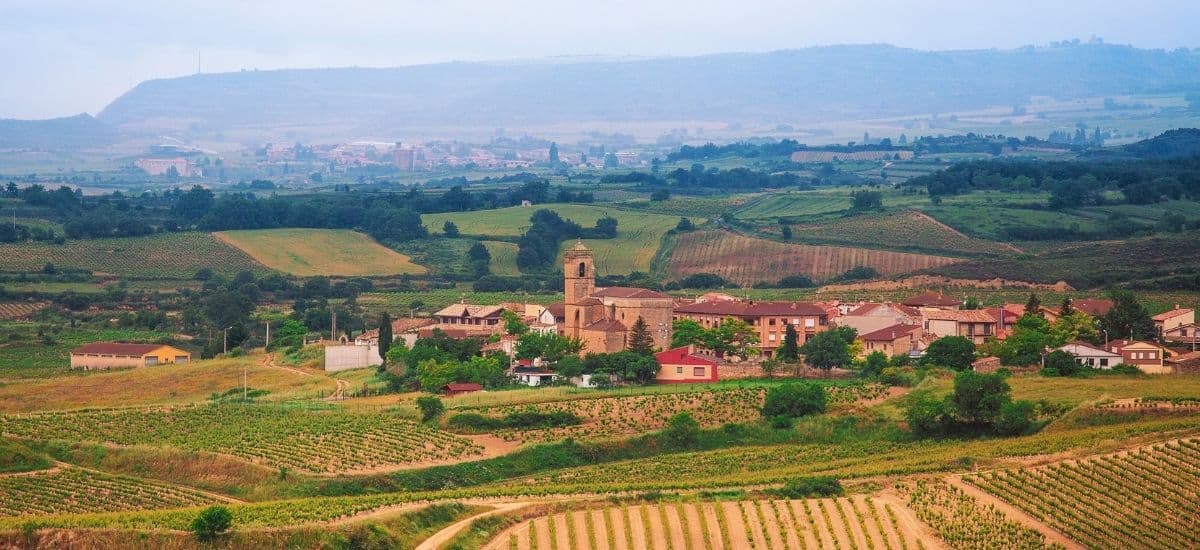 Cava proves that great sparkling wine does not have to come from Champagne.
From Cocktail Hour to the Collector's Shelf
This is where Cava becomes a favorite among the people who pour wine for a living. Because it is made by the same exacting method as Champagne but grown on less expensive land and produced at scale by historic houses such as Codorníu and Freixenet, it delivers an unusually high level of craft for the money. A well-made bottle can serve as an aperitif, a base for a spritz or a sparkling cocktail, a brunch companion beside eggs and cured ham, and a clean, high-acid partner for fried food, shellfish, or a full meal. Few wines stretch so easily across a day or a menu.
The more recent surprise is what has happened at the top. A wave of quality-minded growers, some so committed to terroir and organic farming that they left the appellation entirely to form stricter labels of their own, pushed the whole category to raise its game. The finest Cavas now rest on their lees for years, developing the nutty, creamy, gently toasted complexity once thought to belong only to far pricier sparkling wines. Gran Reserva and Paraje Calificado bottlings reward both cellaring and genuine attention.
Cava occupies a unique place in the world of sparkling wine, combining centuries of craftsmanship with a distinctly Spanish identity. Its traditional production methods, native grape varieties, and strong value proposition have helped it earn global recognition.
The Takeaway
Cava refuses the false choice between the everyday and the serious, and that may be its quiet genius. It is a wine made with real labor and rooted in a specific Catalan landscape, governed by rules that grow more demanding each year, yet it remains generous enough to open on an ordinary Tuesday without ceremony or guilt. Most sparkling wines ask you to wait for an occasion. Cava simply meets you where you are, whether that is a cocktail before dinner or a celebration that calls for something with history behind it.
For anyone building a deeper understanding of wine, Cava offers a rare lesson in value, place, and ambition all at once. Reach for an inexpensive bottle and you will find honest, refreshing craft. Reach a little higher, toward a Gran Reserva or a single-estate Paraje Calificado, and you will find a sparkling wine capable of standing beside the most celebrated names in the world. The smartest approach is to drink across the range, letting the modest bottles teach you the style and the great ones show you its ceiling. Spain's most versatile sparkler has always been a pleasure. It is now, increasingly, a serious one as well.


