A little before noon near the Rialto market in Venice, fishmongers and office workers press up to the narrow counter of a bacaro and order an ombra, a small glass of house wine, with a few cicchetti on the side. There might be baccalà mantecato on grilled polenta, sardines in saor, or a fried meatball. Ombra means shade, and Venetians like to trace the word to the wine sellers who once moved their casks with the shadow of the bell tower near Piazza San Marco to keep the wine cool. Most people finish in a few minutes and step back out into the calle.
Veneto is one of Italy's most versatile wine regions, producing everything from crisp Prosecco and elegant Soave to the powerful reds of Amarone. Its vineyards stretch from the Alpine foothills toward the Adriatic, with Lake Garda, volcanic soils, and historic winemaking traditions contributing to an extraordinary range of styles.
That easy, daily relationship with wine runs through the whole Veneto, from the lagoon to the hills above Verona, where the region's most celebrated red is made from grapes left to dry for months before they are pressed. Amarone della Valpolicella is one of the great pleasures in wine for anyone who loves a full, rich red, and it is still misjudged more often than it deserves. Around it sits a family of wines most drinkers know by name, including Soave from volcanic hillsides, Prosecco from the steep slopes of Conegliano and Valdobbiadene, and the bright reds and rosés of Lake Garda.
 An agriturismo is an Italian farm stay where a working agricultural property also welcomes guests, often with lodging, meals, wine, olive oil, or other products made on-site. In Veneto, they are especially popular because so much of the region’s appeal lies outside the cities, among vineyards, rolling hills, farms, wine roads, Lake Garda, and areas such as Valpolicella and the Prosecco Hills.
The Veneto Runs From Alpine Peaks to Salt Water
The Veneto fills the northeastern corner of Italy, bordered by Friuli-Venezia Giulia to the east, Trentino-Alto Adige and a short stretch of Austria to the north, Lombardy to the west, and Emilia-Romagna across the Po to the south. Its northern edge is mountain country, the eastern Dolomites and the Venetian Prealps, while more than half of the region is plain running down to the Adriatic and the lagoon. Between the two lies a band of hills, from the Monti Lessini above Verona to the Berici and Euganean hills near Vicenza and Padua and the slopes around Conegliano, and most of the finest vineyards sit there. Lake Garda's eastern shore marks the western edge.
Few wine regions capture the diversity of Italian winemaking quite like Veneto, where delicate sparkling wines and powerful, age-worthy reds emerge from the same remarkable landscape.
Winemaking here is ancient. In the sixth century, Cassiodorus, a senior official of Italy's Ostrogothic court, urged the tax officer of the Venetian province to buy acinaticum, a wine from around Verona made from grapes hung through the autumn and pressed in winter. By the sixteenth century the Republic of Venice ruled most of the mainland, and its ships carried sweet wines from Crete and the Greek islands to northern Europe.
The grapes, though, are mostly the region's own. Corvina, along with its larger-berried neighbor Corvinone, gives Valpolicella and Bardolino their cherry fruit and fresh acidity, with Rondinella alongside. Garganega is the white grape of Soave, and Glera is the grape of Prosecco. Lake Garda's southern shore grows Turbiana for Lugana, the plains along the Piave keep the dark, sharply acidic Raboso, and the hills between Verona and Vicenza hold Durella for sparkling wine.
Why Dry a Perfectly Ripe Grape?
Amarone begins at harvest, when growers in Valpolicella choose their loosest bunches of Corvina, Corvinone, and Rondinella and lay them in crates or on bamboo racks in drying lofts called fruttai. The grapes rest there for roughly three to four months, a process known as appassimento, and lose a third or more of their weight as water evaporates and sugar, acid, and flavor concentrate. Traditional lofts rely on open windows and lake breezes, while many estates now use fans and humidity control to keep rot away.
The shriveled grapes are pressed in winter, and fermentation in a cold cellar can run for weeks. Amarone is fermented dry, which separates it from its sweet elder, Recioto della Valpolicella. By local tradition, the first Amarone was a Recioto that fermented further than intended, and the name, built on amaro, Italian for bitter, marks the difference.
 Some of Veneto's most powerful reds begin with dried grapes. Amarone's appassimento process concentrates grape components before fermentation even begins.
The wine carried that name on commercial labels from the early 1950s and received its own DOCG at the end of 2009. Corvina and Corvinone must make up 45 to 95 percent of the blend and Rondinella 5 to 30 percent, the wine must reach at least 14 percent alcohol, and it must age two years before release, or four for a Riserva. A good Amarone shows dark cherry, dried plum, cocoa, and sweet spice over firm tannins, with Corvina's acidity keeping the palate lively and a dry, faintly bitter finish. Styles vary widely. Giuseppe Quintarelli and Bertani have long given their wines years in large casks before release, while Romano Dal Forno in the Val d'Illasi makes a denser, more concentrated style.
Basalt, Bubbles, and Lake Light
Verona is the hub, with Valpolicella on its northern doorstep, Soave to the east, and Lake Garda a short drive west. The city has hosted the wine fair now called Vinitaly since 1967, and its Roman arena has staged summer opera since 1913. Its kitchens are built for red wine, from pastissada de caval, horsemeat braised in Valpolicella, to risotto all'Amarone and boiled meats with peppery pearà. East of the city, the castle of Soave looks over hills of Garganega.
The Classico zone around Soave and Monteforte d'Alpone mixes dark volcanic basalt with limestone, and producers such as Pieropan, with its Calvarino vineyard, Gini, Prà, and Inama make dry, saline whites with notes of almond and white flowers that develop for years. Recioto di Soave, made from dried Garganega, was the first Veneto wine to earn DOCG status, in 1998.
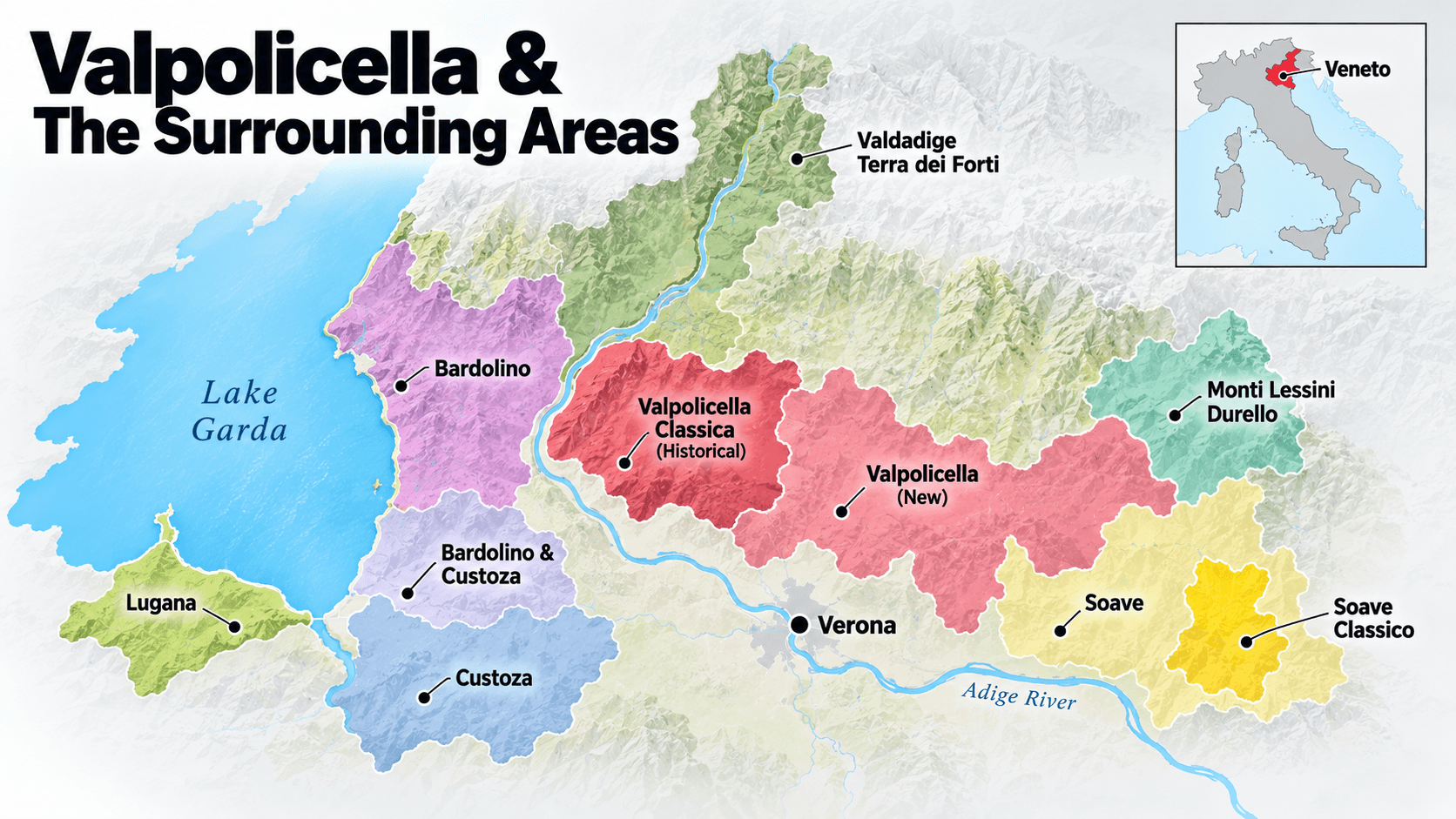
To the west, Lake Garda gives light, cherry-scented Bardolino, its pale Chiaretto rosé, and the white Custoza and Lugana, made for lake fish. Far to the northeast, between Conegliano and Valdobbiadene, Glera grows on hillsides steep enough that much of the vineyard work is still done by hand, a landscape added to the UNESCO World Heritage list in 2019. The Conegliano Valdobbiadene DOCG holds the most prized Prosecco, including the single hill of Cartizze, about 107 hectares, and the cloudy, bottle-fermented Col Fondo style. Most Prosecco takes its bubbles from a second fermentation in pressurized tanks, which keeps Glera's pear and white-flower notes fresh. In Venice it is poured at lunch as readily as at a celebration, beside fried fish or bigoli in salsa.
Veneto is a compelling reminder that great wine regions are rarely defined by a single grape, style, or tradition. From the sparkling wines of the Prosecco hills to the concentrated reds of Valpolicella and the understated elegance of Soave, the region offers a remarkably complete portrait of Italian wine.
The Takeaway
Few wine regions cover so much ground in so short a drive. In a single long weekend, a visitor can taste Prosecco in the hills above Valdobbiadene, Soave beneath its castle, Bardolino on the shore of Lake Garda, and Amarone in a Verona osteria, nearly all of it made from grapes rarely grown anywhere else. Amarone remains the region's strongest case.
Its price and strength lead many drinkers to save it for rare occasions, yet anyone who loves a full, rich red will find a different kind of depth in it, built in the drying loft, with savory, bittersweet edges and Corvina's natural acidity holding it together. An hour in a decanter and a plate of braised beef or aged Monte Veronese are all it needs to show its best, and the finest bottles can age for decades.
The easiest way to learn the Veneto is to drink the way the Venetians and Veronese do, a small glass at a time. Bars and osterie across the region pour Valpolicella, Ripasso, and Amarone by the glass, and in Verona the Valpolicella on the counter sometimes carries several years of bottle age, served as casually as house wine anywhere else. Tasted side by side, those glasses show how one family of grapes changes with drying and time, and a plate of cicchetti or a bowl of pastissada shows how the food was made to meet them. For anyone who loves wine, the Veneto is as rewarding to visit as it is to drink from.


