How Wine Tasting Became a Discipline
For most of history, people drank wine and declared it good or bad. The journey from instinct to analysis is one of the most fascinating untold stories in the world of wine.
Wine has been tasted for as long as wine has existed. Ancient Sumerians ranked wines from different regions in the third millennium BCE. Aristotle proposed classifying them by the four elements. But for millennia, evaluating wine remained essentially subjective, a matter of preference expressed in language that was poetic, vague, or both. A wine was noble or common, masculine or feminine, generous or thin. These terms communicated mood more than meaning, making it nearly impossible for two tasters to know whether they were describing the same experience.
The transformation of wine tasting from casual opinion into structured analysis is a surprisingly recent development. It runs through university laboratories in California, the writings of a French oenologist who changed how professionals think about flavor, the creation of a visual tool that gave the world a shared vocabulary for aroma, and the formalization of a deductive method that turned sensory observation into a professional skill. For anyone who has wondered why sommeliers swirl, sniff, and stare at a glass with such intensity, the answer lies in innovations that unfolded largely within the last seventy years.
Wine tasting is often perceived as an indulgent ritual, but at its highest level, it is a disciplined system rooted in history, sensory science, and structured analysis.
From Poetry to Precision
The first serious attempt to bring scientific rigor to wine evaluation took place at the University of California, Davis, in the late 1950s. Professors Maynard Amerine and Edward Roessler developed a 20-point scoring system designed to assess wines produced in the university's experimental program. The system was built around identifying flaws rather than celebrating virtues, awarding points for the absence of defects in categories like appearance, color, aroma, and taste. It was blunt by today's standards, but it marked a critical departure from the impressionistic tradition that had governed wine assessment for centuries. For the first time, two different tasters could apply the same framework to the same wine and reach comparable conclusions.
The next leap came from France. Emile Peynaud, a professor of oenology at the University of Bordeaux and one of the most influential wine thinkers of the twentieth century, published his landmark Le Gout du Vin in 1983. Peynaud recognized both the necessity and the limitation of language in tasting, observing that it is impossible to describe a wine without simplifying and distorting its image. His contribution was to articulate the sensory process itself, breaking tasting into sequential stages that moved from appearance through aroma to palate, emphasizing that each stage offered distinct categories of information. His framework gave professionals a foundation for approaching wine as something that could be read and interpreted rather than merely enjoyed.
 As global wine culture continues to evolve, the ability to taste and communicate wine effectively has become more valuable than ever. Whether for enjoyment or expertise, understanding wine tasting transforms every glass into a deeper experience.
The Wheel That Changed the Conversation
If Amerine brought measurement and Peynaud brought philosophy, it was a sensory chemist at UC Davis named Ann C. Noble who solved the language problem. When Noble joined the university's Department of Viticulture and Enology in 1974, she quickly discovered that the wine world lacked any standardized vocabulary for describing what people actually smelled and tasted. Professionals relied on terms like harmonious, elegant, or dense, words that carried no precise sensory meaning and made both research and communication unreliable. A winemaker describing a wine as earthy might mean something entirely different from a critic using the same word.
Noble's response, developed through extensive research and published in 1984, was the Wine Aroma Wheel. This deceptively simple visual tool organized more than 80 aroma descriptors into three concentric tiers, moving from broad categories at the center like fruity, floral, or spicy, to increasingly specific terms at the outer ring, where fruity might narrow to citrus and then to grapefruit. The wheel deliberately excluded subjective terms and insisted on language rooted in identifiable sensory references. Its impact was enormous. For the first time, a novice taster and a veteran winemaker could point to the same descriptor and know they were discussing the same sensation. The Aroma Wheel became the foundational vocabulary tool for wine education worldwide and remains in wide use today.
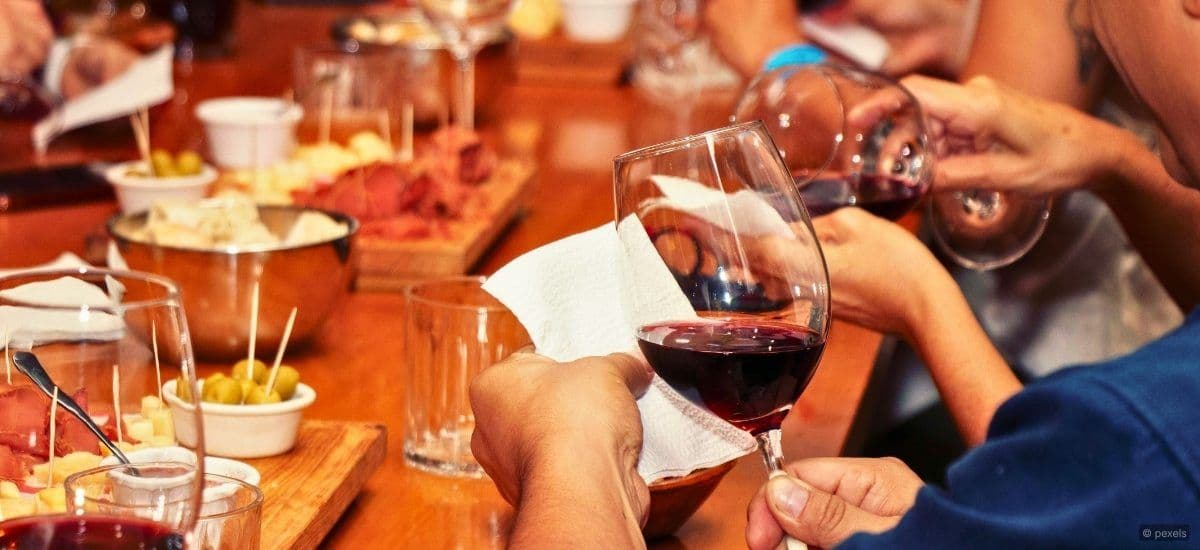 Deductive Tasting is a structured method of analyzing wine to determine its identity based on sensory evidence.
Deduction as Professional Practice
The final piece of the modern tasting framework arrived through the sommelier profession. The Court of Master Sommeliers, founded in London in 1977 and expanded to the Americas in the decades that followed, developed the Deductive Tasting Method, a systematic protocol that guides a taster through the sequential evaluation of a wine's appearance, nose, and palate before arriving at conclusions about its identity, origin, and quality. The method's name is precise: it is deductive in the logical sense, requiring the taster to build a chain of evidence from observable facts in the glass and arrive at a conclusion supported by that evidence.
The deductive grid was designed with a practical purpose rooted in restaurant service. A sommelier working a dining room needs to assess an unfamiliar wine quickly, describe it to a guest, identify potential faults, and recommend it with confidence. The grid formalized those skills into a teachable, testable framework. In the blind tasting portion of the Court's advanced and master-level examinations, candidates are given six wines and 25 minutes to identify the grape variety, country, region, appellation, and vintage of each using nothing but their senses and the deductive process. It is one of the most demanding exercises in professional gastronomy, and it has elevated analytical tasting from a useful skill to a defining credential of the sommelier profession.
Wine tasting sits at the intersection of tradition and technique, blending centuries of history with modern analytical frameworks. What appears subjective is, at the professional level, remarkably structured and repeatable.
The Takeaway
The history of analytical wine tasting is a story about the effort to turn a private sensory experience into a shared, communicable discipline. From Amerine's scoring sheets to Peynaud's philosophical framework, from Noble's Aroma Wheel to the Court of Master Sommeliers' deductive grid, each innovation addressed a specific problem: how to evaluate wine objectively, how to understand what tasting involves, how to talk about flavor in terms that mean the same thing to everyone, and how to train professionals to identify a wine from the evidence it leaves in a glass.
None of these tools claims to capture everything a wine is. Peynaud himself acknowledged that language inevitably simplifies and distorts. But what they collectively accomplished is remarkable. They transformed wine tasting from an act of instinct into a discipline that can be taught, practiced, and refined over a career. For the sommelier choosing wines for a restaurant list, the buyer evaluating samples for a retail shelf, or the student learning to trust their palate, analytical tasting is the foundation upon which every professional decision rests. The glass has not changed. What changed is how carefully we learned to pay attention to what is inside it.


