The Wines of Alsace: Aromatics, Terroir, and Tradition
On a sunlit ribbon of vineyards between the Vosges mountains and the Rhine, France makes some of its most distinctive and age-worthy whites. To understand them is to understand a borderland that has belonged to two nations and kept the best of both.
Drive the wine road through Alsace and the first thing you notice is that France does not quite look like France here. The villages are a storybook of half-timbered houses and flower boxes, the menus offer sauerkraut and bacon tarts, and the older generation still slips into a German-rooted dialect between sentences. Then you open a bottle, and the label names the grape rather than the place, a habit borrowed straight from across the Rhine. Alsace is French soil with a German accent, and that double identity is the key to everything in the glass.
These are not wines that hide. They are dry, aromatic, bracingly fresh, built for the table, and capable of aging for decades. Riesling is the benchmark, but the whole region rewards attention. To understand why, it helps to trace the history that shaped Alsace, the mountains that protect it, and the grapes that have made it one of the most quietly distinctive wine regions in Europe.
 Alsace occupies a unique place in the wine world. Located along France's eastern border with Germany, the region combines French winemaking traditions with a strong Central European cultural influence.
French or German? A Question Alsace Has Never Settled
Alsace has spent much of its history being handed back and forth between two powers. It was French until the Franco-Prussian War ended in 1871 and Germany annexed it, German until the close of the First World War returned it to France in 1918, then seized again by Nazi Germany in 1940 before being restored after 1945. Few European regions have changed nationality so often in living memory, and each transfer left its fingerprints on the culture.
Those fingerprints are everywhere, and several of them sit directly in the wine. Alsace labels its bottles by grape variety, the German custom, while nearly every other French region leads with place. It grows German varieties such as Riesling and Gewürztraminer, fills tall, slender flute bottles in the Rhine style, and pairs the results with a cuisine of choucroute, tarte flambée, and pungent Munster cheese. Yet the winemaking sensibility is thoroughly French, prizing dryness, restraint, and a fierce attachment to terroir. Alsace did not choose between its two parents. It kept the most useful traits of each.
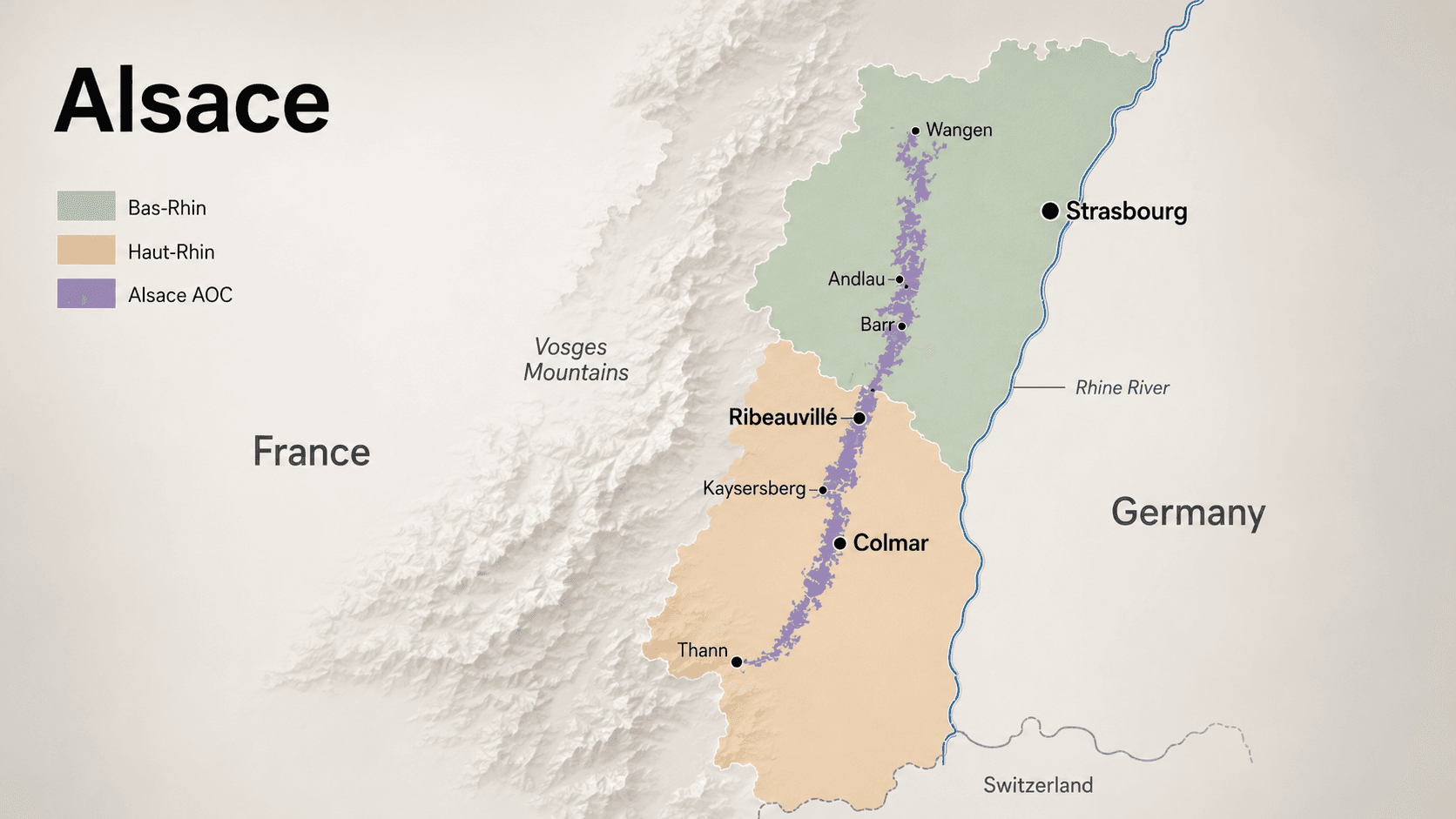 The Vosges Mountains create a rain shadow effect that protects vineyards from excessive rainfall. Alsace contains granite, limestone, sandstone, volcanic, and clay soils within a relatively small area.
In the Shadow of the Vosges
The reason Alsace can ripen these grapes at such a northern latitude comes down to a wall of rock. The Vosges mountains rise to the west, intercepting the rain-laden Atlantic weather systems that sweep across France and wringing them dry before they reach the vineyards. The result is a rain shadow so pronounced that Colmar, the region's wine capital, is among the driest cities in the country, with roughly five hundred millimeters of rain a year. Sun and dryness let the grapes ripen fully while cool nights preserve the racy acidity that defines the style.
Protected by the Vosges Mountains, Alsace enjoys one of the driest climates in France, creating ideal conditions for producing aromatic white wines.
Beneath the vines lies one of the most varied geological mosaics in the wine world, with more than a dozen soil types, granite, limestone, schist, sandstone, volcanic rock, and marl among them, sometimes shifting within a single slope. This diversity is the foundation of the region's fifty-one Grand Cru vineyards, named sites that have functioned as individual appellations since 2011, each held to stricter yields and reserved for the noble grapes. As in Burgundy, the finest expressions come from specific hillsides whose character the wine faithfully reports.
 Throughout history, Alsace has alternated between French and German control, influencing its culture and wine traditions.
Riesling, the Ringer
Four grapes carry noble status in Alsace, and each speaks in its own register. Riesling is the aristocrat, steely and floral, almost always dry, and counted among the longest-lived white wines on earth. Gewürztraminer is its flamboyant opposite, perfumed with lychee, rose, and spice. Pinot Gris brings weight and a smoky richness, while Muscat performs the rare trick of tasting like fresh grapes in a fully dry wine. Around these sit Sylvaner, Pinot Blanc, and Pinot Noir, the region's only red and an increasingly serious one, along with the traditional-method sparkling Crémant d'Alsace.
What unites them is a gift for the table. High acidity and aromatic intensity make Alsace whites among the most versatile food wines anywhere, equally at home beside the region's own rich pork and cabbage or the spiced and fragrant dishes that overwhelm lesser bottles. They also age with grace, the best Rieslings unfolding over twenty years or more, while the late-harvest Vendanges Tardives and noble-rot Sélection de Grains Nobles deliver lusciously sweet wines of real pedigree. Riesling, dry and seemingly ageless, is the ringer that proves the whole region's class.
Alsace is defined by aromatic white wines, a dry continental climate, and remarkable geological diversity. The region's position between the Vosges Mountains and the Rhine River creates favorable growing conditions that preserve acidity while allowing full ripening.
The Takeaway
Alsace is proof that a contested border can yield something neither side would have made alone. From France it took a near-religious devotion to terroir and a preference for dry, disciplined wines. From Germany it took the grapes, the varietal labeling, and the slender bottles. The sunlit corridor beneath the Vosges turned those inheritances into whites of remarkable clarity, precision, and staying power, wines that taste unmistakably of a specific place even as they wear a German name.
For the drinker, this makes Alsace unusually welcoming. The grape on the label tells you most of what you need to know before you buy, so there is little of the decoding that other French regions demand, yet the ceiling is extraordinary. Begin with a dry Riesling that costs less than its quality suggests, then climb toward a Grand Cru bottling that will reward a decade or two of patience. Pour it alongside almost anything and it will rise to the occasion. Few regions offer so much pleasure, so much history, and so much honest value in a single glass.


