The Oregon Trail
The same valley that once marked the end of a great American migration has become an unlikely promised land for one of the world's most demanding grapes. In a single generation, Oregon turned a reckless bet on Pinot Noir into a wine region spoken of alongside Burgundy.
In the middle of the nineteenth century, tens of thousands of settlers loaded their lives into wagons and set out across two thousand miles of prairie, mountain, and river toward a single destination. The Oregon Trail ended in the Willamette Valley, a broad and fertile basin in the state's northwest that promised rich soil and a gentle climate. For the families who survived the journey, the valley was the reward at the end of an almost unimaginable ordeal, a green and temperate land worth crossing a continent to reach.
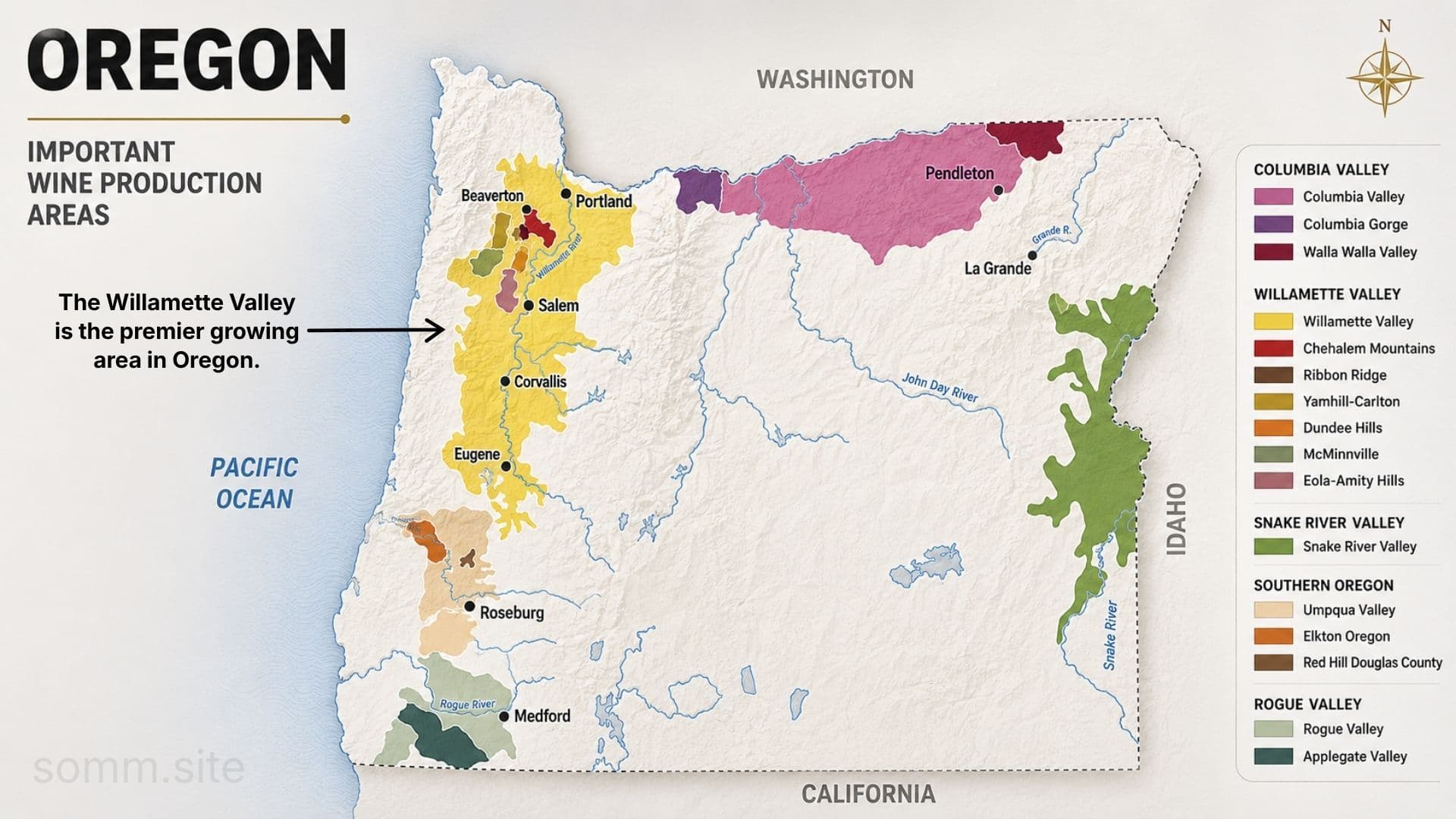
Oregon has become one of the world's premier regions for cool-climate wine production. Although the state produces a variety of grapes, it is internationally recognized for Pinot Noir, which thrives in the temperate conditions of the Willamette Valley.
Today a quieter migration is underway toward the very same ground. Winemakers, including some of the most storied families of Burgundy, along with a growing throng of Pinot Noir devotees, are drawn to the Willamette Valley for reasons the pioneers would recognize. In the span of a single generation, this once-overlooked corner of the wine world has become one of its most admired. The story of how that happened begins with a bet that almost everyone thought was foolish.
A Bet Almost Everyone Thought Was Foolish
In 1965, a young winemaker named David Lett planted Pinot Noir in the Willamette Valley, convinced that its cool, damp climate secretly resembled that of Burgundy. The conventional wisdom said he was wrong. California, with its reliable sunshine, was where serious American wine was being made, and rainy Oregon seemed far too cold and unpredictable for a grape as fussy as Pinot Noir. Lett, later affectionately called Papa Pinot, was undeterred, and a small band of like-minded pioneers, among them Dick Erath, Dick Ponzi, and David Adelsheim, soon followed him north.
Vindication arrived faster and more dramatically than anyone expected. In 1979, Lett's 1975 Eyrie Pinot Noir was ranked among the finest Pinots in the world at a celebrated blind tasting in Paris. Stunned, the Burgundian producer Robert Drouhin organized a rematch the following year, pitting the Oregon wine against his own cellar. The Eyrie finished a hair behind Drouhin's grand cru Burgundy, a result that sent a shock through the wine establishment. Drouhin's response was the ultimate compliment. He bought land in the Dundee Hills and, in 1987, established Domaine Drouhin Oregon. Burgundy itself had blessed the upstart.
 Influenced by the Pacific Ocean, protected by mountain ranges, and shaped by diverse soils, Oregon offers ideal conditions for elegant, balanced wines.
Why Does Burgundy's Grape Feel at Home Here?
The pioneers turned out to be right about the land. The Willamette Valley sits close to the forty-fifth parallel, almost exactly the latitude of Burgundy, and it shares much of that region's temperate rhythm. Winters are cool and wet, summers are warm but rarely scorching, and autumn arrives slowly, giving grapes a long, unhurried stretch in which to ripen. Cold Pacific air slips inland through a break in the Coast Range known as the Van Duzer Corridor, cooling the vines through the heart of the growing season.
This gentle pace is precisely what Pinot Noir craves and so seldom finds. Slow ripening preserves the bright acidity that keeps the wine lively, holds alcohol in check, and allows the grape to develop perfume and detail rather than mere weight. The valley's soils deepen the effect, from the red volcanic clay called Jory to bands of ancient marine sediment and windblown silt, each lending its own accent to the wine. The result is Pinot Noir of finesse and transparency, an unmistakable New World cousin to the wines that first inspired the planting.
The Burgundy of America
Pinot Noir remains the heart of the Willamette Valley, accounting for roughly sixty percent of the state's vines. Alongside it grows Chardonnay, Pinot Noir's classic Burgundian partner and now a serious wine in its own right, as well as Pinot Gris, the popular white that Lett was also the first to plant in the country. Riesling and a fast-rising category of traditional-method sparkling wine complete the picture. This is, in essence, Burgundy's family of grapes, transplanted an ocean and a continent away.
The past twenty-five years transformed a quiet backwater into a genuine phenomenon. A valley that held barely two dozen wineries in the early 1980s now counts around eight hundred, and its terroirs have been mapped into eleven nested sub-appellations. Burgundy keeps arriving in person, with the great house of Louis Jadot founding its Résonance estate and other celebrated names following Drouhin's path, while large American companies have invested heavily in vineyard land. As fine Burgundy has grown scarce and staggeringly expensive, Oregon offers much of the same finesse for a fraction of the price, earning it a fitting nickname, the Burgundy of America.
 Over the past five decades, the state has grown from a small experimental wine region into one of the most respected producers in North America.
Beyond Burgundian Varietals
Pinot Noir and its Burgundian cousins may define the Willamette Valley, but they tell only part of Oregon's story. Travel south into the warmer, drier country of Southern Oregon and the whole palette shifts. The Rogue Valley, the state's hottest growing region, ripens Mediterranean and Bordeaux varieties that would never fully sweeten in the fog-cooled north, among them Syrah, Tempranillo, Cabernet Sauvignon, and Grenache. Tucked inside it lies the Applegate Valley, a sun-drenched corridor sheltered by the Siskiyou Mountains, where warm days and sharply cooling nights coax both structure and freshness from Rhône grapes like Viognier and Mourvèdre alongside robust reds. Growers here are famously willing to experiment, and Southern Oregon as a whole now cultivates dozens of distinct varieties.
Head east instead and the landscape changes again in the Columbia Gorge, a striking appellation that straddles the great river dividing Oregon from Washington. It is often called a world of wine in forty miles, and the phrase is barely an exaggeration. At the cool, wet western end near Hood River, the vineyards yield crisp Riesling, Gewürztraminer, and Pinot Noir. Move eastward toward the high desert and the rain falls away, the heat climbs, and the plantings turn to Syrah, Cabernet Sauvignon, and Zinfandel, with Rhône and Spanish varieties filling the temperate middle. Oregon, it turns out, is not a one-grape state at all but a mosaic of climates, each writing its own chapter in the glass.
The defining feature of Oregon wine is its climate. Cool Pacific air moves inland through the Coast Range, moderating temperatures during the growing season while allowing grapes to ripen slowly. This extended growing season preserves acidity and encourages complex flavor development, particularly in Pinot Noir and Chardonnay.
The Takeaway
The symmetry is difficult to ignore. The original Oregon Trail carried weary families to the Willamette Valley in search of fertile promise, and a century and a half later the same valley has become a promised land for a grape that most of the New World found nearly impossible to grow well. What began as a single stubborn planting on a rainy hillside is now a benchmark region, discussed in the same breath as some of the oldest and greatest names in wine. Few transformations in the modern wine world have been so complete or so swift.
For anyone curious about where cool-climate wine is heading, Oregon rewards a close look. Its Pinot Noir offers the fragrance and precision that make the style so beloved, often at prices Burgundy left behind long ago, and its winemaking culture favors patience, place, and restraint over sheer power. The path that David Lett and his fellow dreamers blazed is well traveled now, yet the wines waiting at the end of it still feel like a discovery. To pour a glass of Willamette Valley Pinot Noir is to taste the reward of a wager that once looked reckless and now looks like foresight, and a reminder that some of the most compelling chapters in wine are still being written.