Exploring the Wines of South Africa
At the southern tip of the African continent, where two oceans meet and mountains tumble toward the sea, one of the most geographically gifted wine regions on earth is finally getting the attention it deserves.
South Africa occupies a singular position in the wine world. Its winemaking history stretches back more than 360 years, making it the oldest of the New World producers, yet for much of the twentieth century it was virtually invisible on the international stage. The reasons were political rather than viticultural. Decades of apartheid and the trade sanctions that followed cut South African wines off from global markets while Australia, Chile, and California were building their reputations. When those barriers fell in the 1990s, what the world discovered was a country of extraordinary natural endowment for growing grapes.
Nearly all of South Africa's vineyards lie within the Western Cape, clustered around Cape Town in a landscape of rugged mountains, river valleys, and the converging influences of the Atlantic and Indian Oceans. The diversity of terroir is remarkable, producing everything from bold Bordeaux-style reds and cool-climate whites to the country's signature Pinotage and some of the most compelling Chenin Blanc grown anywhere. For the curious drinker, South Africa represents one of the great discoveries still waiting to happen.
South Africa is one of the oldest wine-producing countries outside of Europe, with wine production dating back to the 1600s.
Where Two Oceans Shape the Vine
The geography of South African wine begins with the Cape itself, a dramatic meeting point of the cold Benguela Current from the Atlantic and the warmer Agulhas Current from the Indian Ocean. This collision of water temperatures creates a Mediterranean climate of warm, dry summers and cool, wet winters ideally suited to viticulture. Vineyards are rarely found more than 50 kilometers from the coastline, and cooling sea breezes that funnel through gaps in the Cape mountain ranges create a patchwork of mesoclimates that shift meaningfully from one hillside to the next. A prevailing southeasterly wind known locally as the Cape Doctor blows through spring and summer, reducing disease pressure and contributing to overall vine health.
The soils are equally varied. Stellenbosch, the country's most celebrated district, contains more than 50 distinct soil types within its borders, ranging from decomposed granite on mountain slopes to sandy alluvial loam in the valleys. Walker Bay's vineyards sit on weathered shale. The ancient granite and schist of Swartland produce wines of striking mineral character. This geological complexity, layered beneath a climate shaped by two oceans and shielded by mountains rising sharply from coastal plains, gives South African winemakers access to growing conditions that can accommodate virtually any major grape variety in the world.
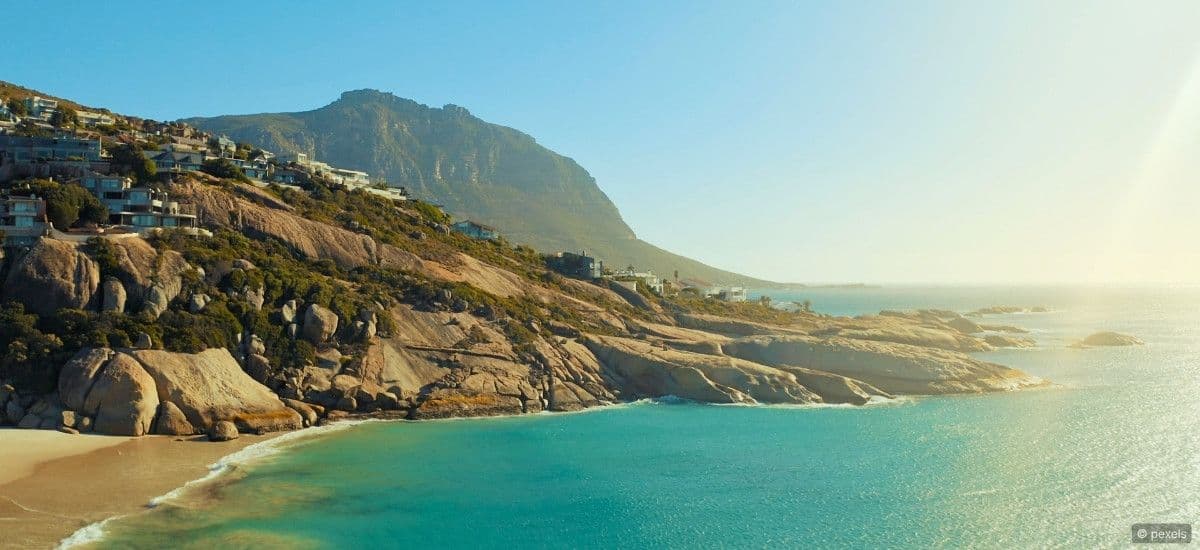 The cool Benguela Current from the Atlantic Ocean plays a major role in cooling vineyards. Cape Town coast pictured above.
A History Interrupted
Vines were first planted at the Cape in 1655 by Dutch settlers of the East India Company, and by 1659 the colony's founder, Jan van Riebeeck, had recorded the pressing of the first South African wine. The arrival of French Huguenot refugees in the 1680s brought skilled viticulture to regions like Franschhoek and Stellenbosch, and by the eighteenth century, the sweet wines of Constantia had earned international fame, appearing on the tables of European royalty. It was a promising beginning, but the centuries that followed brought repeated disruption. Phylloxera devastated the Cape's vineyards in the 1880s. The formation of the powerful KWV cooperative in 1918, while stabilizing a fragile industry, incentivized bulk production over quality for decades.
The most consequential setback was political. The apartheid system, formalized in 1948, led to international boycotts and trade sanctions that severed South Africa from global wine markets from the 1960s through the early 1990s. During those decades of isolation, the industry turned inward, producing largely for domestic consumption while the rest of the New World raced ahead. When apartheid ended and Nelson Mandela was elected president in 1994, South African wine reentered a global marketplace that had changed enormously. The learning curve was steep, but the raw material was extraordinary, and a new generation of winemakers moved quickly to close the gap.
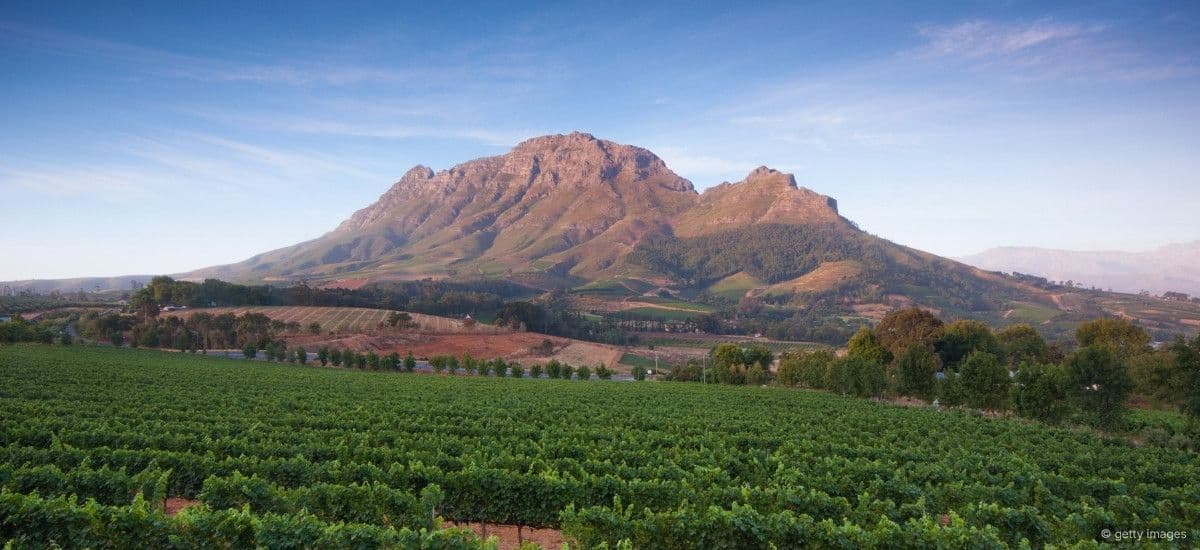 The Western Cape’s Mediterranean climate is ideal for growing high-quality wine grapes. The regions of Stellenbosch pictured here.
What Fills the Glass Today
The modern South African wine landscape is defined by its range. Chenin Blanc is the country's most planted grape, known locally as Steen, and the best examples, particularly from old bush vines in Swartland and Stellenbosch, have established South Africa as arguably the world's leading source of serious, age-worthy Chenin. The grape produces everything from crisp, unoaked styles to richly textured barrel-fermented bottlings, a versatility that mirrors the diversity of the landscape itself. Cabernet Sauvignon thrives in the warm soils of Stellenbosch, producing structured reds with a savory complexity that sits comfortably between Old World restraint and New World generosity. Pinotage, a uniquely South African crossing of Pinot Noir and Cinsault created in 1925, remains a fascinating grape whose best bottlings offer smoky, dark-fruited depth unlike anything else in wine.
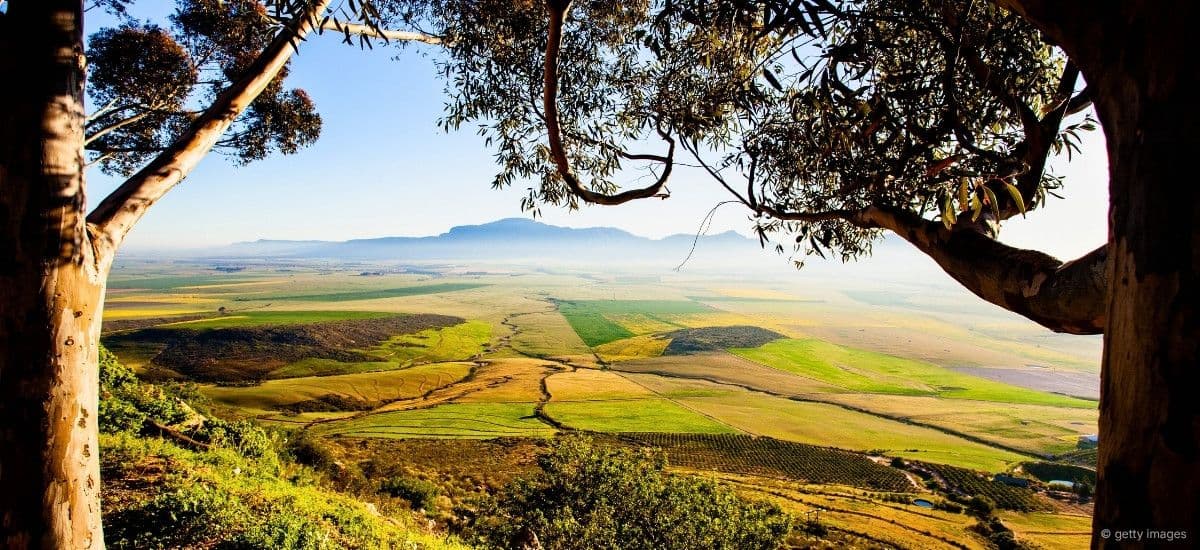 Swartland has become one of the most exciting regions for natural wine and innovative winemaking.
Cool-climate districts like Elgin, Walker Bay, and the Cape South Coast are producing increasingly refined Pinot Noir, Chardonnay, and Sauvignon Blanc, while the Swartland revolution, driven by young producers working with old vines and minimal intervention, has brought international acclaim to a region once dismissed as bulk wine country. In an irony of history, the isolation that apartheid imposed on Swartland's cooperative growers meant that ancient vineyards were never ripped out for fashionable varieties, preserving old-vine material that today's winemakers have turned to extraordinary advantage. The Rhone-style blends emerging from Swartland's granite and schist soils have drawn favorable comparisons to the southern Rhone, and the quality-to-price ratio across South African wine consistently surprises drinkers accustomed to the markups of more established regions.
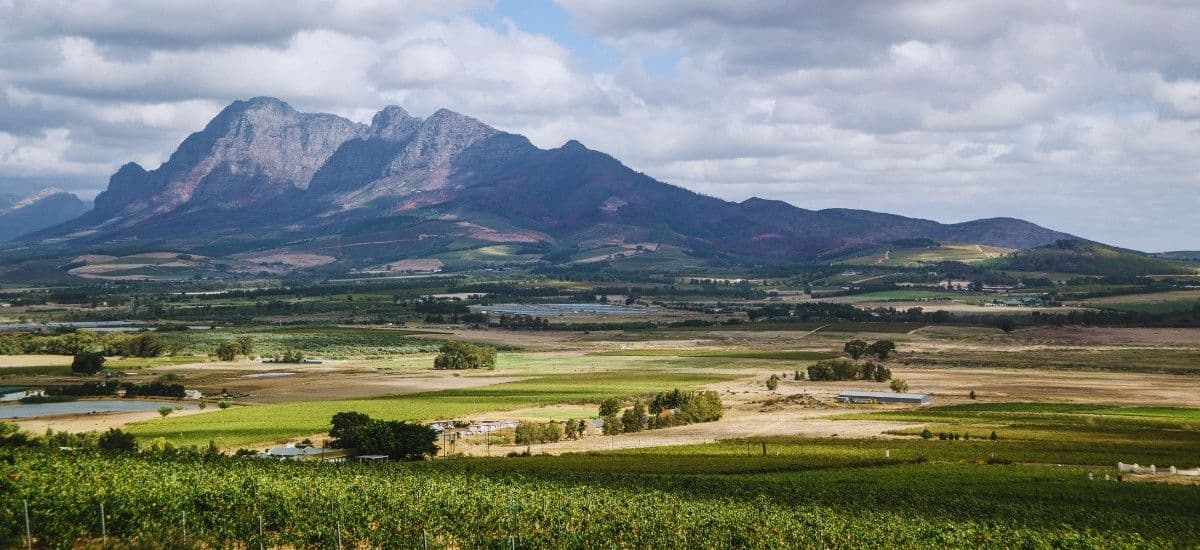 Some of the world’s oldest Chenin Blanc vines are found in South Africa. The Paarl region pictured above.
The Takeaway
South Africa's wine industry is a story of resilience meeting opportunity. The country possesses natural advantages that rival or exceed those of any wine-producing nation: a Mediterranean climate moderated by two oceans, an extraordinary diversity of soils and elevations, and a winemaking tradition that predates most of the New World by a century or more. What held it back was never the land or the talent but a political history that isolated its producers during the very decades when global wine culture was expanding most rapidly.
That chapter is now firmly in the past. The generation of winemakers who have come of age since 1994 are producing wines of genuine world-class quality, from the terroir-driven Chenin Blancs and Syrahs of Swartland to the polished Cabernets of Stellenbosch and the elegant Pinot Noirs of Walker Bay. The industry's ongoing commitment to matching grape varieties and clones to specific sites continues to sharpen the precision of what goes into the bottle. For the wine lover looking for depth, diversity, and value in a single origin, South Africa may be the most rewarding destination available right now. The world almost missed this wine country. It would be a shame to miss it twice.


