The Wines of Canada Explained
Canada is one of the last places most people think of when they think of wine. That is exactly why it deserves a closer look.
The words "Canadian wine" tend to produce one of two reactions: surprise that Canada makes wine at all, or a vague association with icewine and not much else. Both responses undersell what is quietly becoming one of the most interesting cool-climate wine stories in the world. Canada's vineyards span more than 31,000 acres across four provinces, home to over 600 wineries producing wines that extend well beyond the frozen-grape dessert category for which the country is known. The challenge is that almost nobody outside of Canada gets to taste them.
The vast majority of Canadian wine is consumed domestically, with very little reaching international markets. Domestic wines account for less than a third of what Canadians themselves drink, a remarkable statistic for a wine-producing nation and a reflection of both the industry's modest scale and the realities of producing wine where winter temperatures plunge well below freezing. Yet within those constraints, Canadian winemakers have carved out a genuine identity, crafting wines of vibrant acidity and cool-climate precision that draw favorable comparisons to some of Europe's celebrated northern regions.
Canadian wines are defined by their cool-climate character, with bright acidity, precision, and freshness at the forefront.
Where Does Canada Grow Wine?
The answer, for most purposes, is two places: Ontario and British Columbia. Together these provinces account for roughly 95 percent of Canadian wine production, and within each, the vineyards are concentrated in highly specific zones where geography conspires to make viticulture possible despite the country's reputation for punishing winters. In Ontario, the Niagara Peninsula is the flagship, a narrow strip of land between Lake Ontario and the Niagara Escarpment where the moderating influence of the Great Lakes creates a climate mild enough to support Riesling, Chardonnay, Cabernet Franc, and Pinot Noir. Prince Edward County, a limestone-rich island in eastern Lake Ontario, has emerged more recently as a source of taut, mineral-driven Chardonnay and elegant Pinot Noir.
In British Columbia, the Okanagan Valley is the center of gravity, a long, narrow lake valley stretching 160 kilometers north from the Washington State border. Protected by the Cascade and Columbia mountain ranges, the Okanagan is surprisingly arid, with its southern reaches around Osoyoos classified as semi-desert. The result is a growing season of intense sunshine and dramatic temperature swings that support everything from Pinot Gris and Riesling in the cooler north to Merlot, Syrah, and Cabernet Sauvignon in the warmer south. Smaller regions in Nova Scotia and Quebec contribute further diversity, with Nova Scotia's maritime climate producing crisp whites and Quebec exploring cold-hardy hybrids alongside emerging plantings of European grapes.
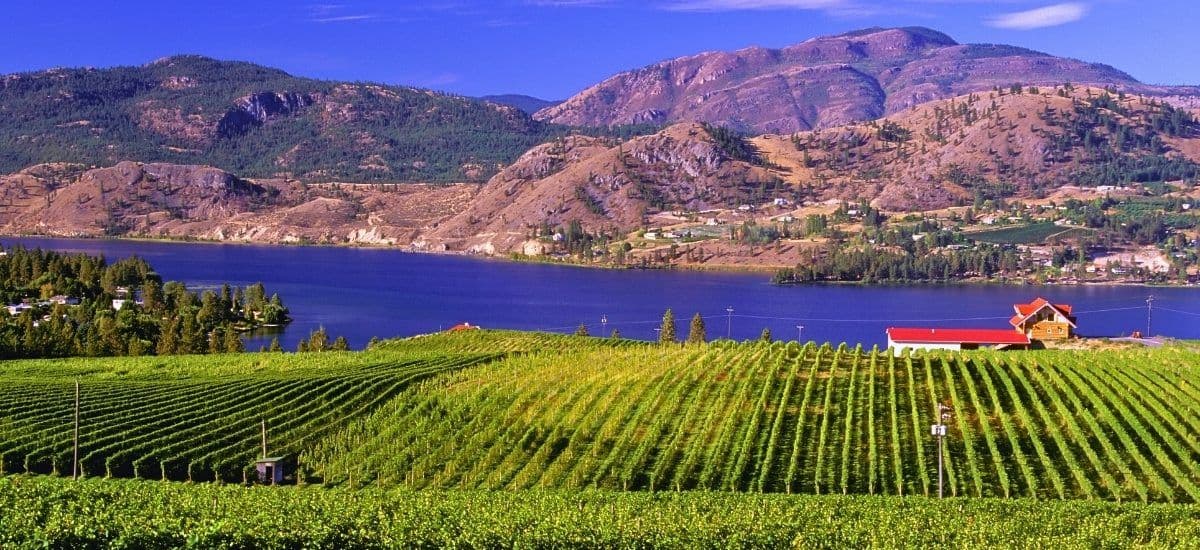 Okanagan Valley is a diverse and rapidly growing region known for its range of climates, producing everything from crisp Riesling to structured Syrah and Cabernet Sauvignon.
A Young Industry Finding Its Voice
Canadian winemaking has roots stretching back to the seventeenth century, but the modern industry is remarkably young. For most of the twentieth century, production in both Ontario and British Columbia was dominated by fruit wines, labrusca table grapes, and French-American hybrids that could survive harsh winters but rarely produced wines of distinction. The pivotal shift came in the late 1980s, when the North American Free Trade Agreement exposed Canadian producers to direct competition from California, Oregon, and Washington. The Canadian government responded with vine-pulling incentive programs that encouraged growers to uproot their hybrid plantings and replace them with vinifera varieties better suited to premium wine production.
The transformation was swift. Within a decade, the vineyards of Niagara and the Okanagan were planted predominantly to the same grape varieties grown in the world's great cool-climate regions. The Vintners Quality Alliance, or VQA, was established to certify wines made entirely from Canadian-grown grapes, providing a quality framework that distinguishes genuine estate-produced wines from blends containing imported juice. This distinction matters because a significant portion of wine sold in Canada under domestic labels has historically included foreign grape material, a practice that has complicated the country's efforts to build international credibility. The VQA designation is the clearest signal that what is in the bottle is authentically Canadian, grown and produced in a specific region with traceable origin.
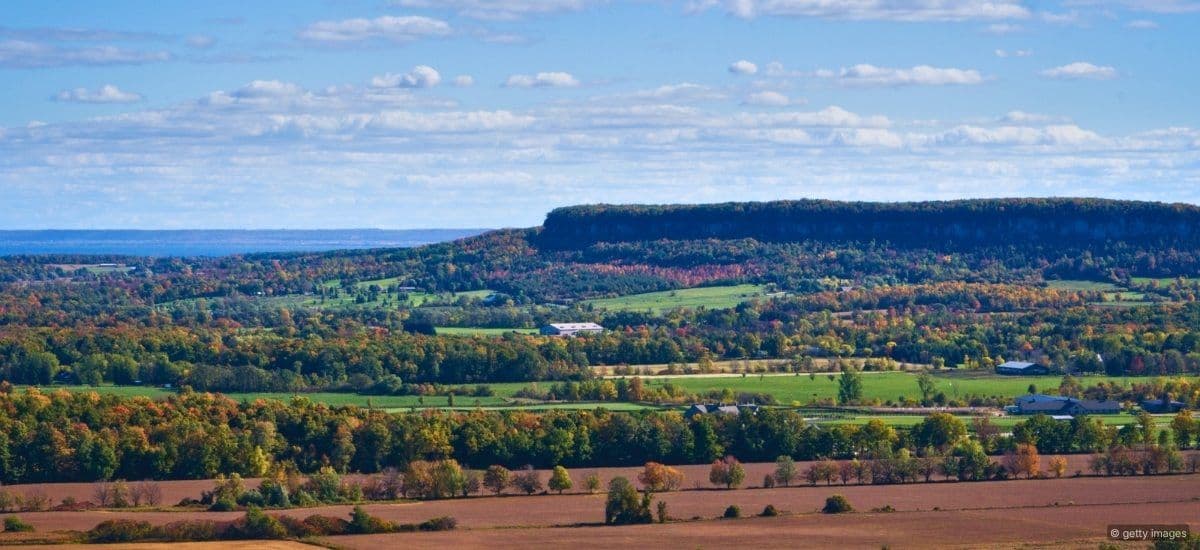 White wines such as Riesling and Chardonnay often show citrus, orchard fruit, and mineral notes, while reds like Pinot Noir and Cabernet Franc lean toward elegance and structure rather than power. Niagara Escarpment subregion pictured here.
Why the World Has Not Yet Noticed
The single biggest reason Canadian wine remains obscure outside its borders is scale. The country's total vineyard acreage is a fraction of what a single large region in France or California cultivates, and the wines produced are consumed almost entirely within driving distance of where they are made. Niagara sits barely an hour from Toronto, Canada's largest city. The Okanagan is a four-hour drive from Vancouver. These built-in local markets absorb most of what the industry produces, leaving very little surplus for export. What does leave the country goes overwhelmingly to the United States, with minimal penetration into Europe or Asia.
Canada has emerged as one of the most exciting cool-climate wine countries in the world, combining technical precision, unique geography, and a growing global reputation for quality across a wide range of styles.
This insularity is both a limitation and, in a sense, a form of protection. Because Canadian winemakers are not yet competing on the global stage at volume, they have been free to experiment, to match grape varieties to specific sites without the pressure of meeting export demand for a narrow range of commercially proven styles. The result is a growing portfolio of wines that reflect their origins with genuine specificity, from the racy, petrol-tinged Rieslings of Niagara to the structured, sun-ripened Syrahs of the southern Okanagan. For the traveler or the curious importer willing to seek them out, these wines represent some of the best value and most distinctive expressions available from any cool-climate region in the world.
 The Niagara Peninsula is Canada’s most famous wine region, known for Icewine, Riesling, Chardonnay, and Pinot Noir, with strong influence from Lake Ontario.
The Takeaway
Canada's wine industry is still in the early chapters of its story, and that is precisely what makes it worth watching. The country's two principal regions occupy latitudes shared with Champagne and the Rheingau, and the best wines emerging from Niagara and the Okanagan increasingly justify the comparison. Riesling, Chardonnay, Pinot Noir, and Cabernet Franc all find expressive, site-specific voices in Canadian soil. Meanwhile, the country's unrivaled expertise in icewine production, where Canada produces more than all other nations combined, has already demonstrated that the very climate which challenges growers also grants them access to a category of wine that no warmer country can replicate.
What Canadian wine needs most is time and the attention that comes with wider exposure. The quality is there. The diversity of terroir is there. The passion of a new generation of winemakers committed to vineyard-driven, regionally authentic wines is unmistakable. What remains is for the rest of the world to discover what Canadians who live near these vineyards already know: that great wine does not require a Mediterranean postcode, that some of the most exciting bottles being produced today come from a country where the vines spend half the year buried under snow, and that the frigid north has far more to offer than anyone who has not yet tasted it would ever expect.


