The Long Memory of Roussillon
Tucked between the Pyrenees and the Mediterranean, a wine region with one foot in Spain has quietly preserved what other places forgot. Its old vines and Catalan soul make it one of the most compelling unfinished stories in the wine world.
There is a corner of France that does not quite feel like France. Pressed against the Pyrenees on its southern flank, brushing the Mediterranean on its eastern edge, and looking across an old border toward Catalonia rather than upward toward Paris, Roussillon occupies a position that is geographic, cultural, and viticultural all at once. The signs are everywhere: the Catalan colors of yellow and red on village walls, the bilingual street names, the agricultural rhythms tied to a climate more Iberian than European.
For wine, this borderland identity has shaped everything. Roussillon produces some of the oldest, most distinctive, and most undervalued wines in the country, and it does so on a foundation of fortified wine traditions that reach back nearly eight centuries. To overlook Roussillon is to overlook one of the most fascinating crossroads in the wine world, a place where history, culture, geology, and grape variety converge into something that exists nowhere else.
Roussillon is one of France’s most historic yet overlooked wine regions, positioned between the Mediterranean Sea and the Pyrenees near the Spanish border. Defined by intense sunlight, rugged terrain, and a deep Catalan cultural influence, the region has long been associated with powerful wines and fortified styles.
A Borderland with Its Own Memory
The political map shows Roussillon as French, and it has been since 1659, when the Treaty of the Pyrenees redrew the border and shifted the region from Spanish hands to French ones. The cultural map tells a different story. Long before any French king claimed the land, Roussillon belonged to the Crown of Aragon and, briefly, to the medieval Kingdom of Majorca, with its capital at Perpignan. The Catalan language took root centuries earlier and remains audible today in village conversations, festival songs, and the bilingual signage that marks the territory. The food, the architecture, the saints' days, and the wine all speak the same dual heritage.
This is not mere historical trivia. Roussillon's identity as a borderland has shaped its agriculture and its viticulture in ways that mainstream French wine culture has not always recognized. The climate is closer to the dry, sunbaked rhythms of Catalonia than to the temperate logic of Bordeaux or Burgundy. The grape varieties favor heat and stress. The traditional winemaking practices, particularly the production of fortified wines, derive from a Mediterranean tradition that extends across the old border into Spain. Understanding Roussillon means accepting that its wines are not simply French wines made in a particular style. They are the products of a culture that predates the modern nation-states and remains, in many essential respects, its own.
 Roussillon is known for both its ancient old-vine plantings and its evolving identity in dry red and white wines. Grenache dominates much of the landscape, thriving in the hot, dry climate and poor soils.
Where the Old Vines Live
Roussillon possesses one of the greatest concentrations of old vines in France, and possibly in the world. The reason is largely economic. While other regions were torn up and replanted during the second half of the twentieth century to chase higher yields and trendier varieties, Roussillon's relative obscurity and modest commercial success kept its ancient vineyards in the ground. Today, head-trained, bush-pruned Grenache vines that are sixty, eighty, and even more than a hundred years old grow across hillsides that have known little else for generations. These vines produce small quantities of intensely concentrated fruit, and they do so in dialogue with a remarkable diversity of soils: schist in Maury, granite in the higher elevations, limestone in pockets, and the iron-rich red soils that give parts of the region their distinctive coloration.
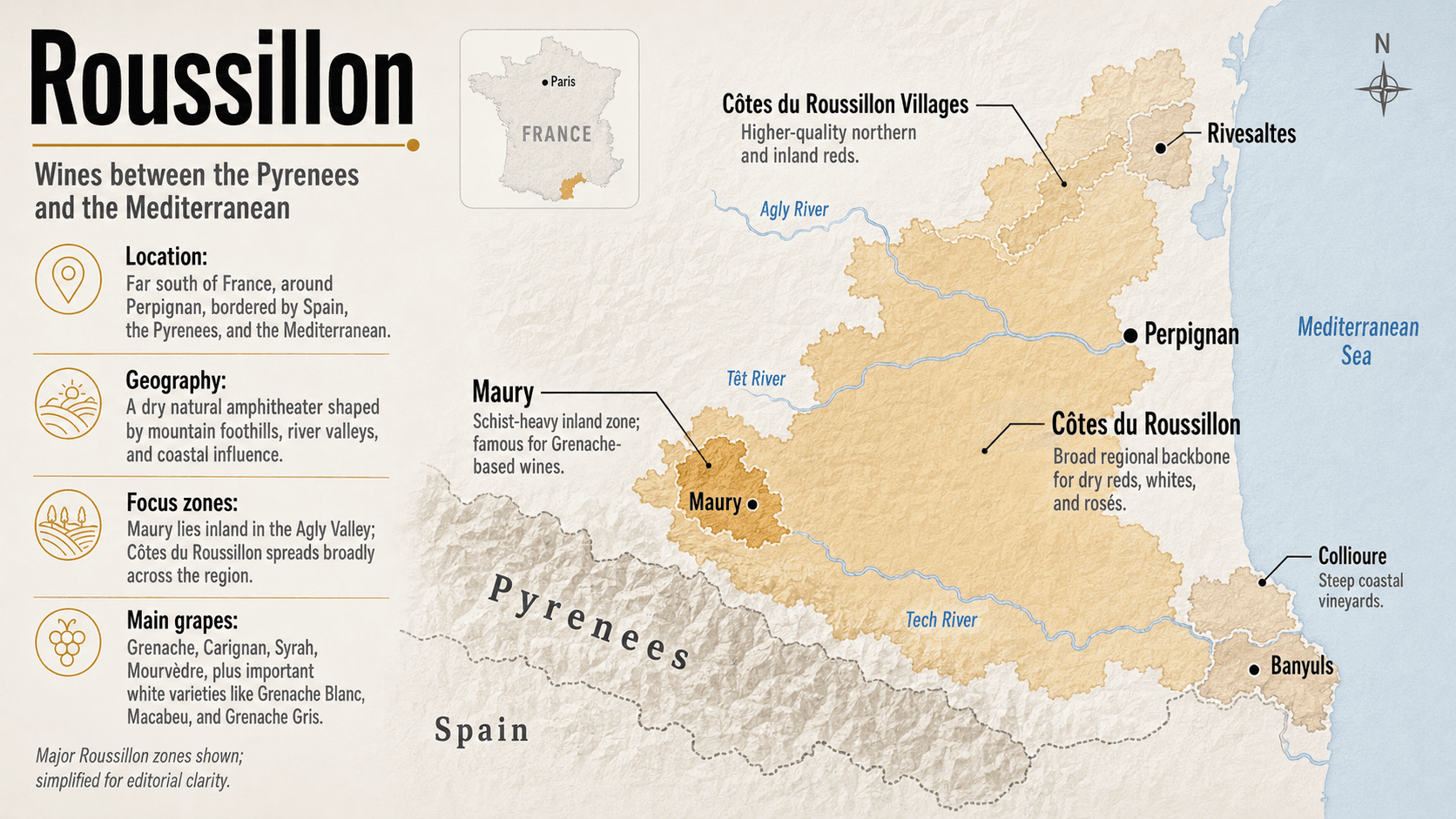 Roussillon is defined by Mediterranean warmth, old-vine viticulture, and a long tradition of fortified wine production.
Maury, in particular, occupies a special place in the conversation. The appellation sits along a narrow valley defined by black schist that breaks down into a sharp, mineral-laden soil that suits Grenache extraordinarily well. The wines that emerge from these old Maury Grenache vines, whether produced as dry reds, sweet fortified bottlings, or both within a single estate's portfolio, carry an intensity and a sense of place that few other regions can match. For decades, this potential remained the secret of a small number of producers and the occasional importer. That secrecy is beginning to give way to wider recognition, but Roussillon's old vines remain one of the most underutilized resources in the French wine landscape.
Why Fortified, and Why Here?
The fortified wines of Roussillon, known collectively as Vins Doux Naturels, are not a recent commercial invention. They are the survival of a winemaking technique attributed to Arnau de Vilanova, the thirteenth-century Catalan physician and scholar at the University of Montpellier who is credited with formalizing the practice of adding grape spirit to fermenting wine to preserve its natural sweetness. The technique, known as mutage, stops fermentation while sugar remains, producing a wine that is both sweet and structurally robust, capable of aging for decades and in some cases centuries. The Crown of Aragon protected and promoted these wines as a regional specialty, and the tradition passed intact into French hands when the border shifted.
Roussillon remains one of the most compelling wine regions in southern France because it refuses to lose its identity. Its wines are shaped by history, heat, old vines, and generations of adaptation to a harsh landscape.
Today the great fortified wines of Roussillon include Maury, Banyuls along the coast near the Spanish border, and Rivesaltes inland. Most are based on Grenache, though Muscat and Macabeu also play important roles. The wines come in many styles, from young, fruit-driven reds to amber-colored bottlings that have spent years in oak or glass demijohns exposed to the sun, developing an oxidative complexity reminiscent of aged Madeira or fine sherry. These are wines of patience and provenance, born from the same hot Mediterranean climate that produces the region's old vine dry reds. The fortified tradition is not separate from Roussillon's identity. It is the thread that connects the medieval period to the present day, and it remains one of the most distinctive contributions any French region has made to the world of wine.
 Roussillon’s identity is deeply connected to its history of fortified wine production, particularly vins doux naturels such as Maury, Banyuls, and Rivesaltes. These wines emerged as practical solutions in a hot climate where ripe grapes and natural sugar levels allowed for fortification and stability.
The Takeaway
Roussillon is a region poised between two truths. It is, by any honest measure, one of the most historically rich and viticulturally promising places in France, and yet it remains, by any commercial measure, one of the least understood. Its old vines, its Catalan heritage, its fortified wine tradition, and its dramatic Mediterranean terroir add up to a story the wine world has only just begun to tell properly. For those who pay attention, Roussillon offers an opportunity rare in modern wine: the chance to discover a region while it is still affordable, still authentic, and still rooted in the practices and the philosophy that shaped it long before the global market arrived.
What makes Roussillon particularly compelling is that none of this is invention. The old vines were not planted yesterday for marketing. The Catalan culture was not retrieved from an archive to add color. The Vins Doux Naturels are not a clever reimagining of something forgotten. Everything that gives Roussillon its character has been there continuously, quietly outlasting the trends and the fashions, waiting for a generation of drinkers and producers ready to understand what it has to offer. The story of this borderland and its wines is one of the most important the wine world has yet to fully hear, and it is, at last, beginning to be told.


