Châteauneuf-du-Pape: Where Popes, Stones, and Grenache Built a Legacy
The southern Rhône's most storied appellation did not become great by accident. It was shaped by papal ambition, ancient soils, and a fierce commitment to protecting what the land could produce.
Few wine names carry as much historical weight as Châteauneuf-du-Pape. Translated literally, it means the Pope's New Castle, a reference to the extraordinary period in the fourteenth century when the seat of the Catholic Church relocated from Rome to the nearby city of Avignon and transformed the surrounding countryside into one of Europe's most important viticultural centers. The village and its vineyards sit in the southern Rhône Valley of southeastern France, roughly 20 kilometers north of Avignon, occupying a sun-drenched plateau scattered with the large, smooth river stones that have become the appellation's visual signature.
Today, Châteauneuf-du-Pape is widely regarded as the benchmark of the southern Rhône, producing full-bodied red blends built primarily around Grenache and supported by a remarkably deep roster of permitted grape varieties. It is also the birthplace of France's entire appellation system, the first wine region in the country to codify rules governing how and where its wines could be made. For the casual enthusiast and the working sommelier alike, understanding Châteauneuf-du-Pape is essential to understanding French wine itself.
Châteauneuf-du-Pape represents more than just a historic appellation, it is a model for how tradition and terroir can command global relevance.
The Popes Who Made the Wine Famous
The story of Châteauneuf-du-Pape as a wine of consequence begins in 1309, when Pope Clement V transferred the papal court from Rome to Avignon. Clement was a known lover of wine, and his arrival in the Rhône Valley brought both attention and resources to local viticulture. But it was his successor, Pope John XXII, who left the most lasting mark. John XXII constructed a grand fortress on the hilltop above the village, which became the papal summer residence, and he invested directly in the surrounding vineyards, improving practices and expanding plantings. The wines produced under his watch became known as Vin du Pape and were served at the palace to ambassadors and dignitaries who carried their admiration back to courts across Europe.
Seven successive popes resided in Avignon until 1378, when the papacy returned to Rome amid the turbulence of the Great Schism. The departure diminished the village's political significance, but the viticultural foundation endured. By the mid-fourteenth century, nearly half the commune's land was already devoted to grapevines, a proportion that speaks to how thoroughly the papal presence had reoriented the local economy around wine. By the late eighteenth century, the wines of Châteauneuf had earned a reputation extending well beyond the Rhône. What the popes had begun as an expression of personal taste had, over centuries, matured into one of the most respected winemaking traditions in France.
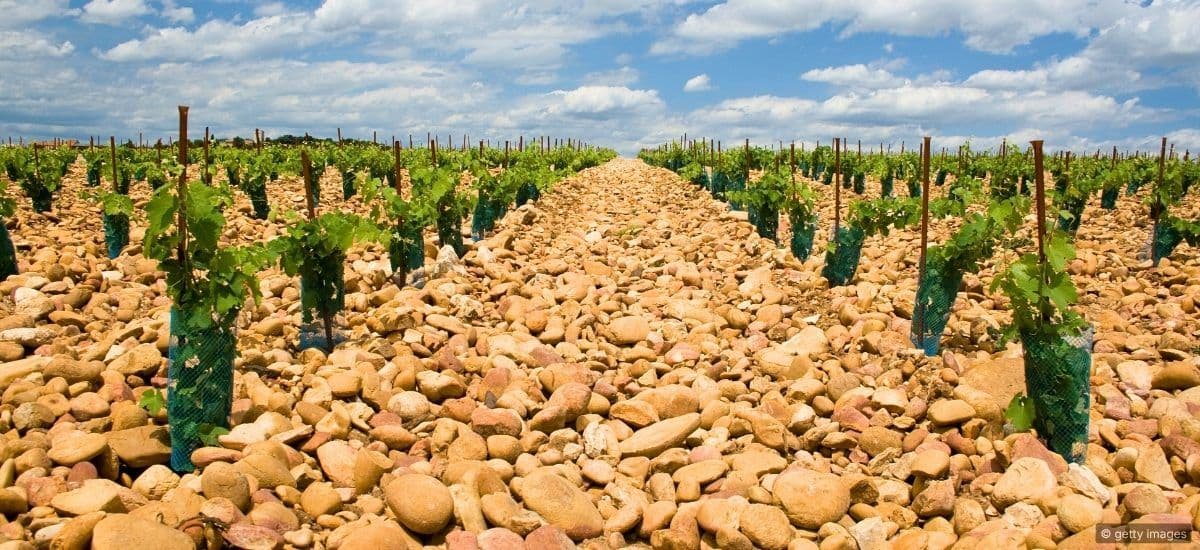 The famous galets roulés, large rounded stones that absorb heat during the day and radiate it back to the vines at night.
Stones, Sun, and the Birth of French Wine Law
The vineyards of Châteauneuf-du-Pape cover approximately 3,200 hectares across five communes, spread over a landscape that appears almost inhospitable at first glance. The most distinctive feature is the galets roulés, large rounded stones deposited by the ancient Rhône that blanket many of the vineyard floors. These stones absorb heat during the long days and radiate it back to the vines after nightfall, extending the ripening process and contributing to the concentrated wines for which the region is known. Not every vineyard sits on galets, however. Beneath and beyond the stones, soils vary from sandy clays to limestone and red sandstone, and this diversity of terroir is one reason the appellation supports so many grape varieties and stylistic approaches.
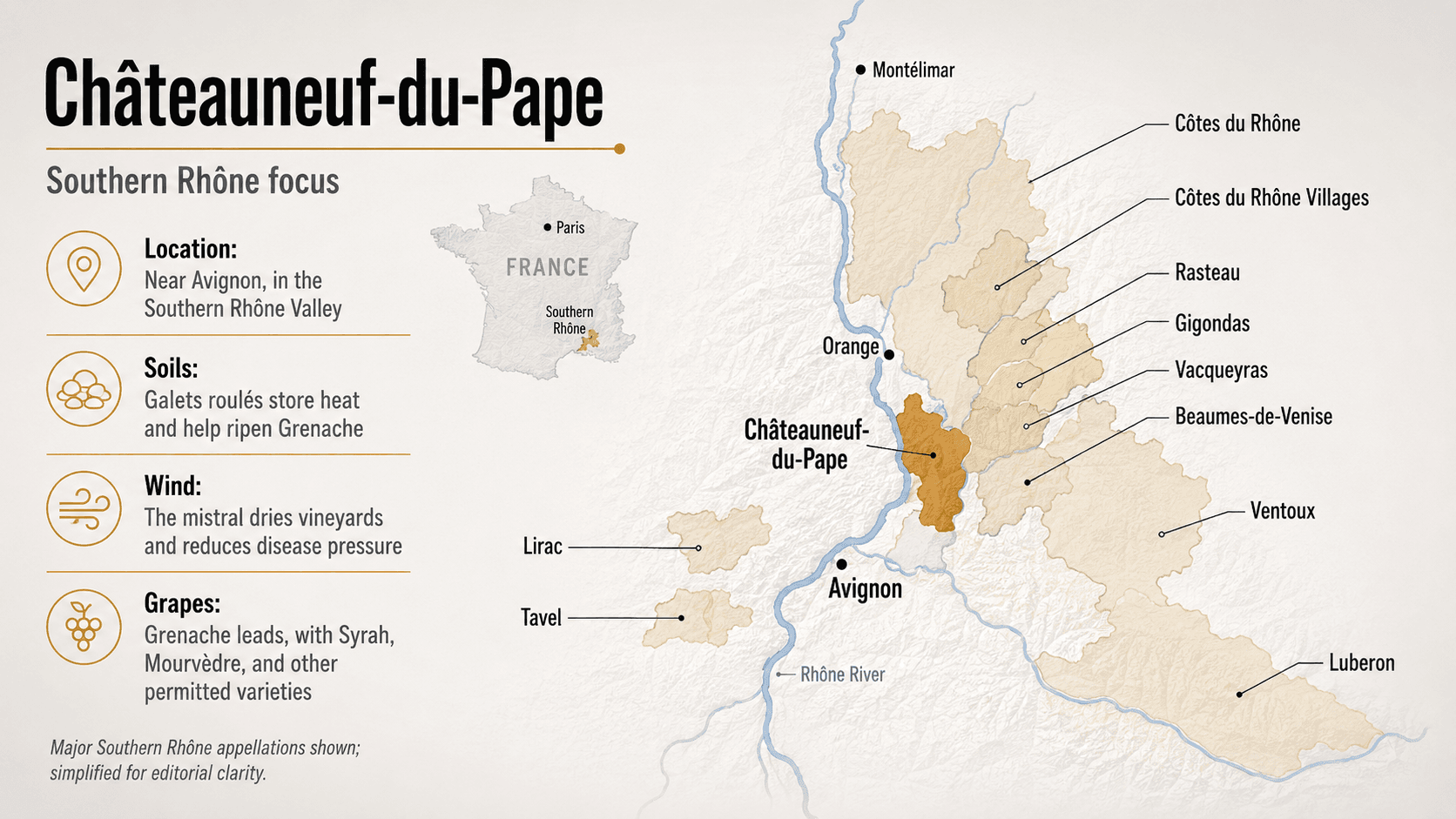 The southern Rhône Valley is filled with lesser known appellations, all positioned around the historic city of Avignon.
The region's significance extends beyond the bottle. In the early twentieth century, rampant fraud threatened the reputation of Châteauneuf-du-Pape, with unscrupulous merchants blending inferior wines under the prestigious name. In response, Baron Pierre Le Roy de Boiseaumarié, owner of Château Fortia, drafted production rules in 1923 that defined permitted grape varieties, minimum alcohol levels, yield limits, and geographic boundaries. These regulations became the template for the entire French Appellation d'Origine Contrôlée system, formally established in 1936 with Châteauneuf-du-Pape among the very first appellations recognized. Every AOC label on every French wine bottle traces its legal lineage to this act of quality protection.
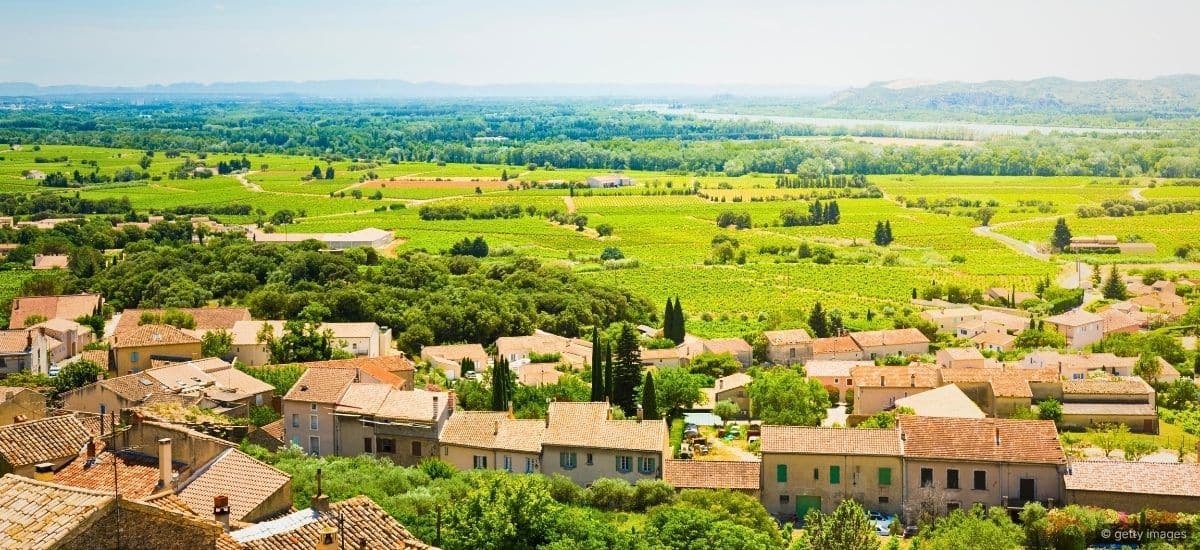 The region is best known for its powerful red blends, typically led by Grenache and supported by a cast of up to 13 permitted grape varieties.
What Arrives in the Glass
Châteauneuf-du-Pape permits eighteen grape varieties in its wines, a breadth virtually unmatched among major French appellations. In practice, the reds are dominated by Grenache, which accounts for roughly 72 percent of plantings and provides the generous red fruit, warmth, and body that form the wine's foundation. Syrah contributes structure, dark fruit, and aromatic spice. Mourvèdre adds color, tannin, and savory depth that anchors the blend as it ages. Together, these three constitute approximately 90 percent of what goes into the bottle, though permitted grapes like Cinsault, Counoise, Muscardin, and Vaccarèse allow producers creative latitude. There is no legal requirement dictating proportions, which means the stylistic range across the appellation is far wider than the single name on the label might suggest.
The resulting reds are powerful, typically reaching 14 to 15.5 percent alcohol, with an aromatic character that often includes ripe raspberry, plum, leather, and a distinctive herbal quality the French call garrigue, evoking the wild scrubland of sage, rosemary, and lavender that surrounds the vineyards. With age, the best examples develop remarkable complexity, moving through stages of dried flowers, tobacco, earth, and spice. White Châteauneuf-du-Pape, though representing only about five percent of production, has grown steadily in quality and reputation, offering full-bodied, aromatic wines made primarily from Grenache Blanc, Clairette, and Roussanne that reward both immediate enjoyment and careful cellaring.
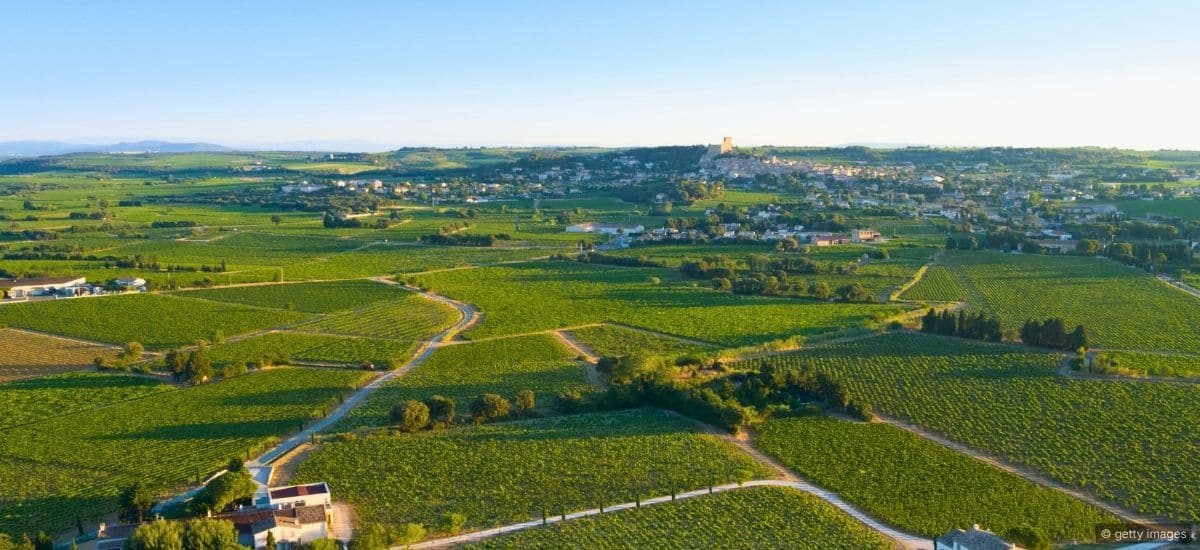 The mistral wind plays a key role, keeping vineyards dry and reducing disease pressure. Some vineyards have soils beyond stones, including sand and clay, which create vastly different wine styles.
The Takeaway
Châteauneuf-du-Pape stands at the intersection of history, law, and craft in a way that few wine regions can match. Its papal origins gave it a name and an early audience among European courts. Its struggle against fraud gave France its foundational quality framework, a system since adopted by wine regions across the globe. And its winemakers, working across centuries with the same sun-baked stones and deep-rooted Grenache vines, have built a body of work that ranges from generous and approachable to profoundly complex.
For the newcomer, a bottle of Châteauneuf-du-Pape is one of the most direct introductions available to the richness of southern French winemaking. For the industry professional, it remains a touchstone, a region whose diversity of styles and producers offers endless ground for study and recommendation. Whether one is drawn to the bold, fruit-forward power of a young vintage or the layered subtlety of a wine with two decades of cellar time behind it, the appellation delivers on a scale that justifies every syllable of its formidable name. To drink Châteauneuf-du-Pape with attention is to taste not just a wine but a living record of what happens when ambition, terroir, and tradition converge on a single hillside and refuse to be separated.


